The Manufacturing Behind Motorsport: DY Composites
Daniel Young, founder of DY Composites, builds precision composite aerodynamic panels for endurance racing, where tight deadlines meet harsh conditions and failure has immediate consequences. For Young, the reward comes from the link between engineering, manufacturing and competition, and from seeing parts leave the factory floor and perform as intended.
Written by Kerryn Caulfield, Executive Director, Composites Australia Inc. and Scott Compson, The Australian Institute of Engineering
Manufacturing composite components for endurance racing requires precision, speed and resilience under strict deadlines. Components are engineered and produced to endure harsh conditions in which failure has immediate consequences. For Daniel Young, founder of DY Composites, the shared commitment to performance makes the challenge worthwhile.
Founded by Daniel Young in 2013 and based in Kilsyth South, Victoria, DY Composites specialises in advanced composite manufacturing for motorsport. Young’s engineering discipline was shaped through his work at Perkins Engineering and Kelly Racing, where he developed specialist expertise in the manufacture of precision composite aerodynamic panels for Supercars racing. Building parts to fixed production timeframes, rather than flexible deadlines, established the benchmark for DY Composites.
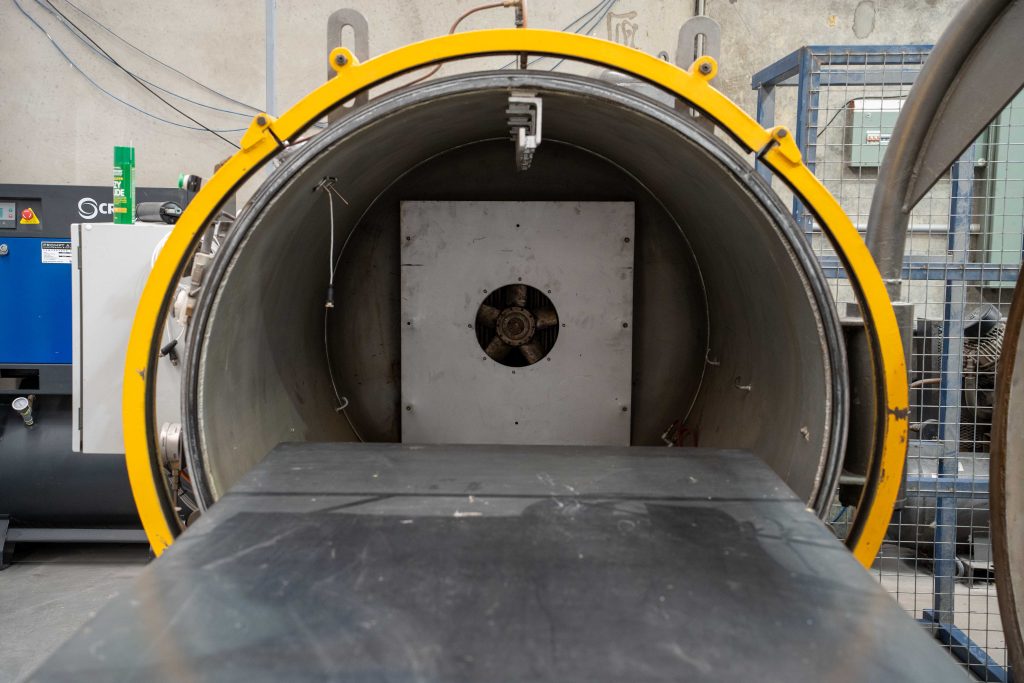
Production begins with CNC programming and pattern-nesting software, which optimise material use and identify potential errors before material is cut. According to Young, “Our core manufacturing capability includes an autoclave with a 1450 mm internal diameter and 2400 mm length, operating at up to 90 psi and 180°C. Autoclave curing is the gold standard for producing ultra-lightweight, high-strength prepreg carbon fibre and composite motorsport components. The process uses precise vacuum pressure, high heat and external gas pressure to ensure uniform curing and strong bonding of composite laminates, delivering the structural integrity required for racing applications.”
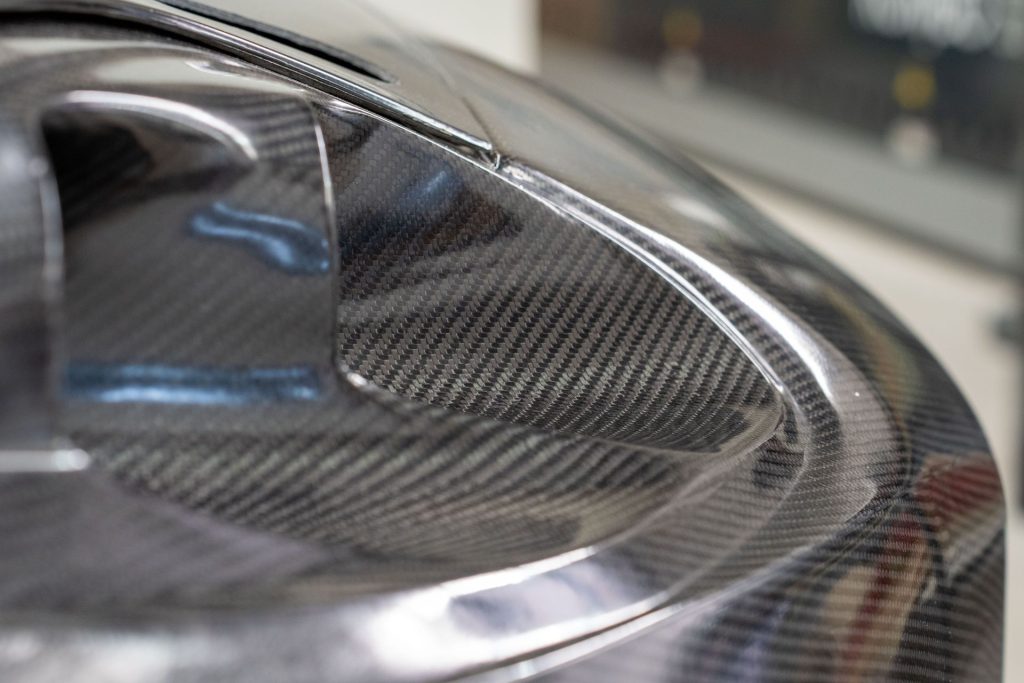
Detail of the headlamp recess on DY Composites' Jaguar XK body, where the twill-weave carbon runs cleanly through a tight compound curve under a clear gloss finish. Image credit Tom Cameron
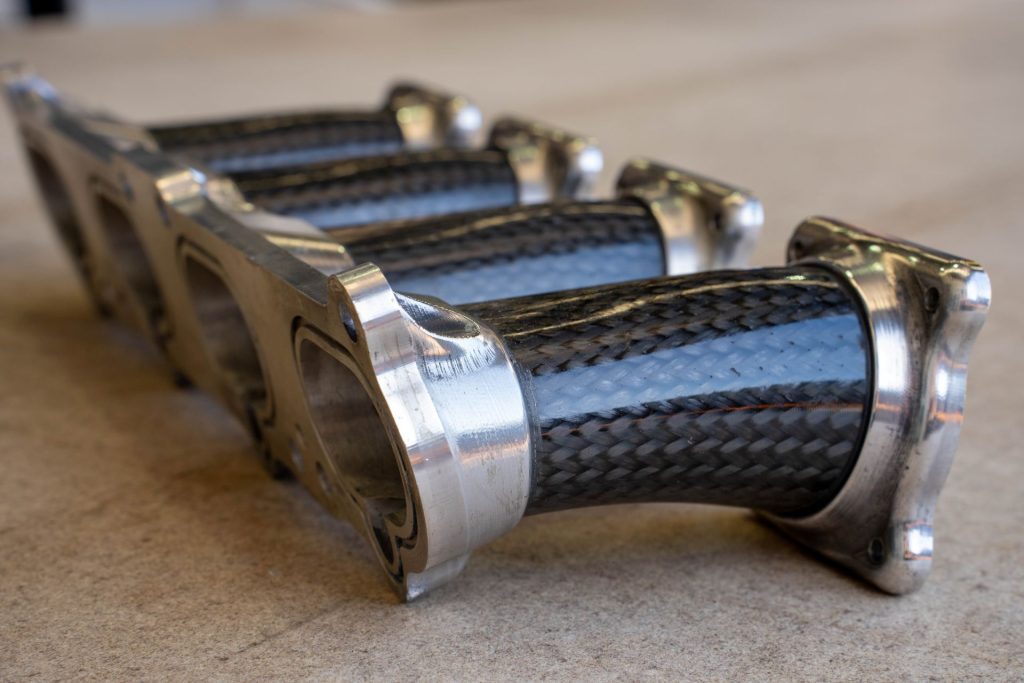
Aluminium and carbon fibre inlet manifold for a Nissan SR20 engine,
produced using resin transfer moulding (RTM). Designed and tooled by
Daniel Young. Image credit Tom Cameron
A temperature-controlled infusion and curing room rated to 50°C, together with a large vacuum infusion facility, supports resin infusion production. The facility also includes a temperature-controlled clean room, a large post-curing oven and a paint and surface-coating area.
After curing, components undergo 3-axis CNC machining and trimming, with 5-axis machining outsourced where required. A SolidWorks CAD/CAM system and two large-scale 3D printers support design, tooling and production, completing an integrated manufacturing capability designed to maintain accuracy from raw material through to finished component.
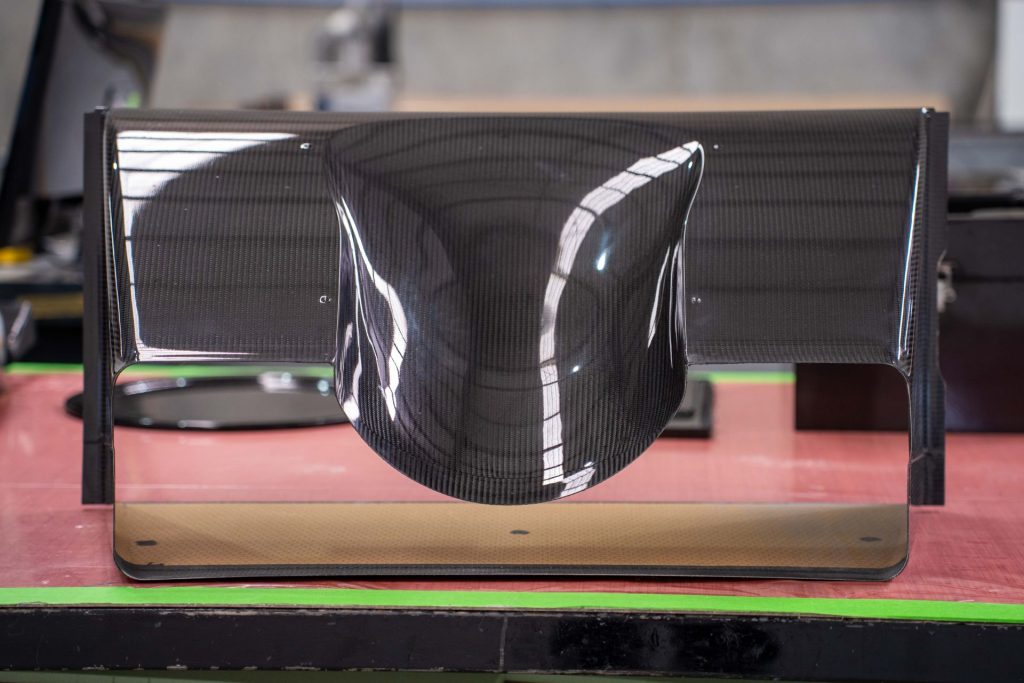
A carbon fibre component fresh from the mould at DY Composites. The complex compound curves and gloss finish show the precision tooling and layup work behind motorsport-grade parts. Photo: Tom Cameron
DY's core manufacturing capability includes an autoclave with a 1450 mm internal diameter and 2400 mm length, operating at up to 90 psi and 180°C. Image credit Tom Cameron
DY Composites is a key supplier to the Supercars championship, providing composite components for GM, Ford and Toyota. The company also works directly with homologation teams to design, engineer, and produce new components. Its current work includes supplying Walkinshaw TWG Racing, which will field the Gen3 Toyota GR Supra for Chaz Mostert and Ryan Wood in the 2026 Repco Supercars Championship. Building components for a manufacturer entering a new season under the Gen3 rules requires precision from the outset, with every component required to meet its specification before installation.
For Young, the skills required to manufacture components for motorsport are developed through both practical experience and formal training. Trade qualifications and engineering studies provide foundations in composite forming, design, CAD, CNC machining, tooling and workplace health and safety, while experience in a motorsport manufacturing environment develops the ability to apply those skills under production pressure.
DY Composites currently supports an apprentice through the Australian Institute of Engineering, working towards a Certificate III in Engineering – Composites Trade. The company also supports higher-level engineering development, with one employee studying Mechanical Engineering at Swinburne University of Technology while contributing to the university’s Formula SAE team as lead chassis designer. A graduate engineer with a Mechanical Engineering degree from La Trobe University has also joined the business.
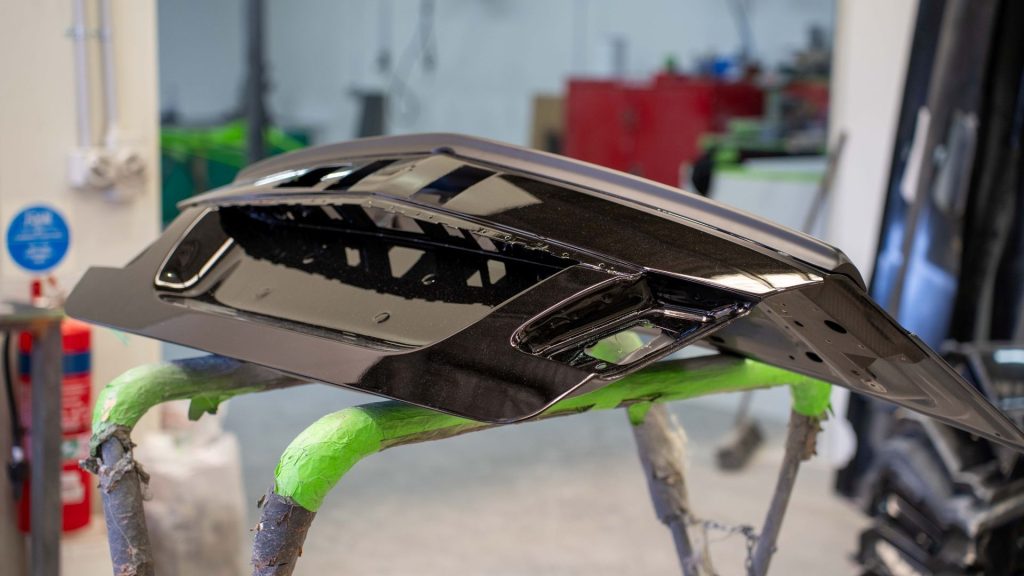
A finished carbon fibre rear bumper, fresh from DY Composites' paint shop. Image credit Tom Cameron
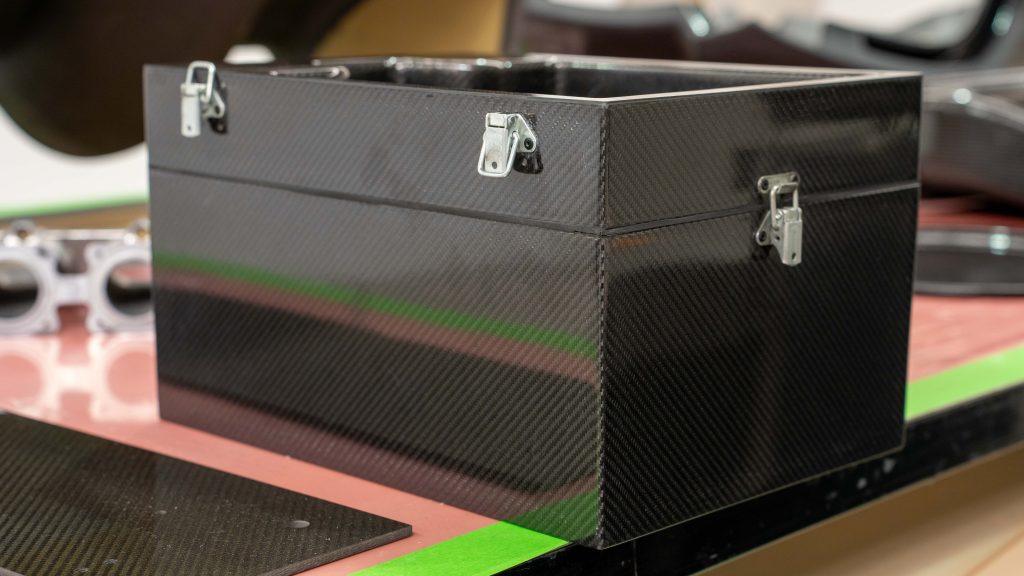
Lightweight and strong, this carbon fibre battery box protects the car's power supply while keeping weight to a minimum. Image credit Tom Cameron
Beyond its own trainee and graduate roles, DY Composites also gives up production time each year to support Formula SAE, the international student motorsport competition in which university teams design, build and race a small open-wheel car each season. DY Composites provides tooling, hard-to-come-by autoclave capacity and post-processing to the Swinburne team to cure a new carbon fibre chassis to competition standard each season. Young says, “It’s a commitment to the next generation of composites practitioners.”
Factory work is generally structured around research, development, testing and production, but the pressure increases in the lead-up to a new upgrade package as deadlines tighten. Race weekends bring demanding travel schedules and a high-adrenaline environment where every split second shows up on the stopwatch and a driver’s mistake can appear instantly in the data.
For Young, however, the attraction lies in the connection between engineering, manufacturing and competition. For people with a genuine passion for motorsport, producing the components that ultimately go onto a race car can be a dream job. The pressure is demanding, but so is the satisfaction of seeing a component move from the manufacturing floor to the track and perform as intended.