Composites in Australian Motorsport – Built in Australia, Raced at 300 km/h

On Mount Panorama's Conrod Straight, Supercars push beyond 300 km/h, loading splitters, underbody panels and aero components, while the Esses, heavy braking, kerb strikes and contact add their punishment. At Bathurst, composite design, manufacturing quality and repairability come together, and a failure can cost far more than a grid position.

By Kerryn Caulfield, Executive Director, Composites Australia Inc and Scott Compson, Trainer and Assessor, the Australian Institute of Engineering

Every splitter, wing, dashboard, roof, bonnet, diffuser and underbody panel on an Australian racing car faces a relentless trial: airflow at speeds pushing 300 km/h, bone-rattling vibration, heat, friction and the unpredictable, harsh jolt of contact.

Composite materials have become an essential part of that environment. Carbon fibre is the headline material where low mass and high stiffness matter most, but it is only part of the story. Glass fibre, aramid and hybrid laminates, often combined with lightweight core materials, also have an important place where cost, impact behaviour, repairability and production method influence the choice. Aluminium and alloy steels remain important across the car as well.

The stakes are high. A component has to perform consistently under race conditions while remaining secure, predictable and safe. A failure can end a competitor’s race, but even relatively minor damage can cost performance. A restricted brake-cooling duct can reduce cooling and compromise brake performance, while damage to a front splitter or undertray can reduce downforce and cornering speed. More serious failures can scatter debris across the circuit, create a hazardous projectile or contribute to a race interruption. Reliability also matters to teams, manufacturers and sponsors, where a highly visible failure can cost track time, results and reputation.

Behind many of these components is a highly capable Australian composites industry, producing everything from one-off aerodynamic parts and replacement panels to tooling, moulds and complete composite assemblies. In motorsport, materials are pushed hard — and the lessons learned on the track continue to drive better manufacturing, repair and processing techniques throughout the wider composites industry.

This edition of Connection dives deeper into that industry: the Australian companies manufacturing, repairing and supporting composite components for Supercars, Trans Am, and the prestige GT and customer racing programs competing across the country. Each category operates under different technical rules, cost structures and performance demands, but beneath them all lies the same need for skilled people who understand materials, processes, precision and the consequences of getting it wrong.
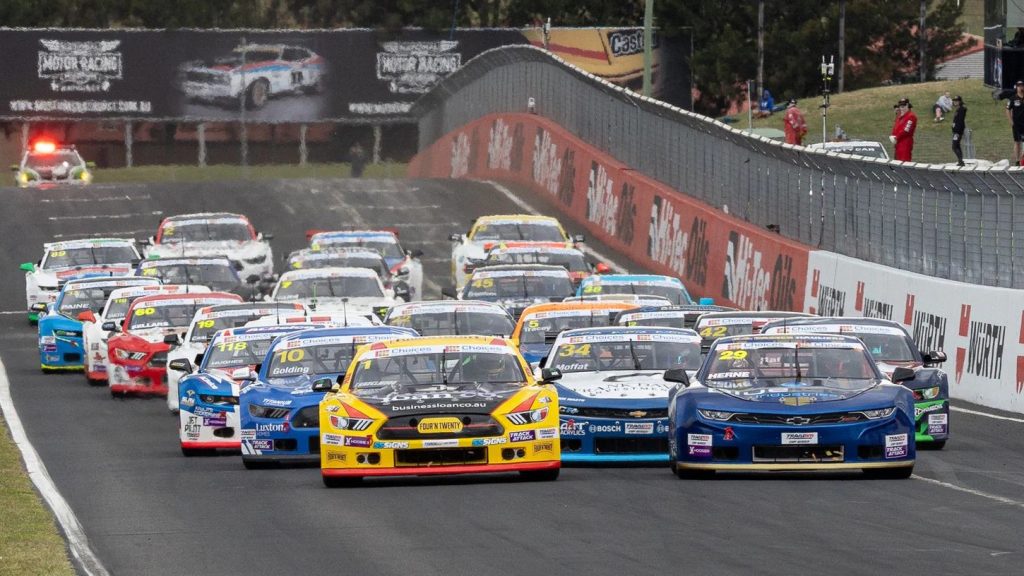

In Trans Am, the composite story is less about pursuing the lightest possible component at any cost and more about producing bodywork that is consistent, repairable and suitable for repeated competition. Jules Ingall, Trans Am Cup Series gallery

Supercars: performance within tight controls

The category operates under a tightly controlled homologation system that defines how each model is built, with extensive parity testing to keep manufacturers closely matched. Composite bodywork and aerodynamic components play an important role, where low mass, stiffness, repeatability and accurate control of shape all matter.

But in Supercars, lighter is not automatically better. The car and some removable body and aerodynamic components must meet regulated minimum weights, with ballast added where required. For composite fabricators, that means controlling dimensions, laminate quality and weight from one part to the next. If a damaged component gains weight through repair, you can reduce ballast while still meeting the minimum. In this environment, every layer of reinforcement and every gram of resin matters.

Weight also matters because of where it sits in the car. Overall vehicle weight, weight distribution, and ballast placement influence handling, while some categories also measure and control centre of gravity. Removing weight high in the body can affect the car very differently than removing the same amount close to the floor. For the composites industry, this distinction matters. Motorsport is not simply about making carbon fibre components as light as possible. It is about controlled mass, repeatability, structural performance, dimensional accuracy and understanding exactly where that mass sits on the vehicle.

The current Supercars field adds another dimension. Ford Mustang and Chevrolet Camaro are now joined by Toyota’s GR Supra, bringing three manufacturers to the grid in 2026. The Holden brand was retired in 2020, although the Commodore continued competing in Supercars until the end of 2022 before the Camaro arrived with Gen3 in 2023.

Each homologated model has its own controlled body surfaces and manufacturer-specific components, while the category works to achieve aerodynamic parity. For composite manufacturers, that places a premium on accurate tooling, controlled manufacturing, repeatable laminate quality and close dimensional control. Small variations in shape, stiffness, fit or mass can have consequences well beyond appearance.

The Supercars field climbs away from the start at Mount Panorama, Bathurst. Heat and exhaust from 25-plus V8s shimmer across the grid, warping the trackside signage and showing how much thermal load these cars carry. Credit Edge Photographics/Supercars

Bathurst: where everything is tested

Mount Panorama’s 6.213-kilometre circuit combines high-speed straights, heavy braking, rapid direction changes, and the unforgiving descent through the Esses. On Conrod Straight, Supercars can push beyond 300 km/h, placing significant loads on splitters, underbody panels and other aerodynamic components. Add vibration, heat, friction, kerb strikes and the unpredictable jolt of contact and the demands on both the material and workmanship become clear. A component failure here can mean far more than losing a grid position. It can reduce performance, end a race, damage other parts of the car, create debris on the circuit or force a team into an urgent repair under race-weekend pressure. That is where design, manufacturing quality and repairability all come together.

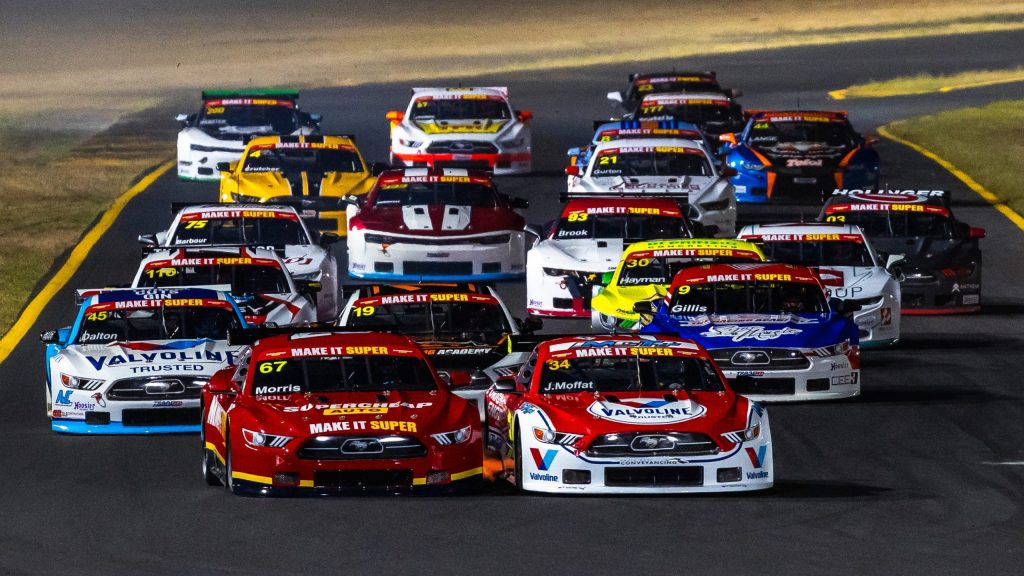
The National Trans Am Series field at the start, with James Moffat (#34) on the front row. The Camaros and Mustangs are built on steel tube-frame chassis with composite body panels, a construction approach closer to NASCAR than to the monocoque Supercars and TCR machines. Photo: Jack Martin / Garry Rogers Motorsport

Trans Am: a different composite brief

Drawing on the heritage of America’s Trans-American muscle-car racing, the Australian series uses purpose-built race cars carrying the familiar shapes of Mustangs, Camaros and Challengers. Cost control is central to the category, so the composite story is less about pursuing the lightest possible component at any cost and more about producing bodywork that is consistent, durable, repairable and suitable for repeated competition. That creates a different brief from Supercars, but one that places just as much emphasis on workmanship and practical repair.

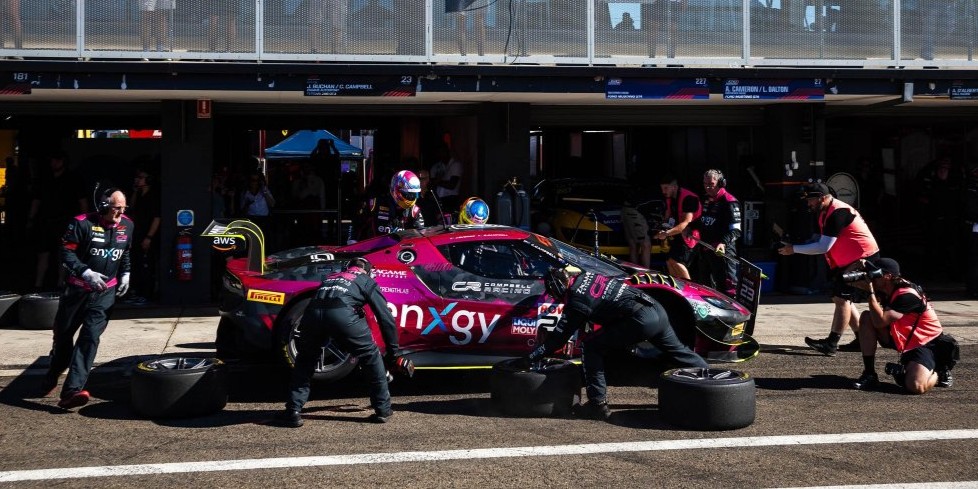
A GT World Challenge Australia pit stop, where crews and composite repairers work against the clock. Source GT World Challenge Australia gallery

GT racing: precision repair and manufacturer control

Then there is the prestige GT and customer racing sector. Manufacturers including Audi, Mercedes-AMG, Lamborghini, Porsche, Ferrari, Aston Martin and McLaren supply highly developed GT racing cars to customer teams around the world, including those competing in Australia.

Here, the role of the local composites industry changes again. The cars and many of their original composite components are manufactured overseas, so Australian expertise is often focused on inspection, damage assessment, repair and replacement in accordance with manufacturer requirements.

The question is not simply whether a carbon component can be repaired, but whether it can be repaired correctly, within the permitted limits and returned to service with confidence. Where repair is not permitted or damage exceeds the allowable limits, replacement becomes the only option. That requires technicians who can recognise impact damage, delamination, crushed core, fibre failure and damage that may extend well beyond what can be seen on the surface.

John Barnard designed the McLaren MP4/1, which introduced the carbon fibre composite monocoque to Formula One in 1981. That July, John Watson drove it to victory at the British Grand Prix, the first Grand Prix win for a carbon fibre chassis. Pictured at the McLaren Technology Centre, Woking, UK. Photo: Curt Smith/Wikimedia Commons, CC BY 2.0

Advanced composites — against the race clock

Motorsport draws on many advanced-composites techniques also seen in industries such as aerospace: controlled laminating, vacuum consolidation, prepreg processing, bonded construction, controlled curing and detailed inspection.

What makes racing different is the clock. Damage sustained in one session may need to be assessed and dealt with before the next—sometimes within hours—creating an unusual balance between precision and speed. A repair still has to follow the correct process, but the workshop may be operating in a pit garage, at night, with the next practice session or race already counting down. There is little room for shortcuts, because a repair that fails at speed can have consequences far beyond a lost lap.

Across Supercars, Trans Am and GT racing, the constant is people.

Advanced materials and sophisticated manufacturing processes only work when technicians understand fibre orientation, resin systems, core materials, bonding, curing, surface preparation, tooling, inspection and repair. They also need the judgement to recognise when a component can be repaired, when it must be replaced and when something that looks acceptable on the surface may be hiding more serious damage underneath.

For plenty of young rev heads, working on the engineering behind a Supercar or repairing the carbon structure of a GT3 car is close to the ultimate job. But enthusiasm for racing is only the starting point.

The industry needs people who can combine practical composite skills with disciplined processes, technical understanding and the ability to work accurately under pressure. The pathways into that work can run through Australia’s Vocational Education and Training system or through engineering education, with each developing different parts of the capability the industry needs.

Bathurst - Mount Panorama’s 6.213-kilometre circuit combines high-speed straights, heavy braking, rapid direction changes, and the unforgiving descent through the Esses. On Conrod Straight, Supercars can push beyond 300 km/h, placing significant loads on splitters, underbody panels and other aerodynamic components.