Built In-House: Garry Rogers Motorsport’s Manufacturing Edge
Australia's oldest motorsport team, Garry Rogers Motorsport designs, builds and maintains its own cars across four categories, and has long been an early adopter of advanced materials and manufacturing methods. Auto Action from GRM gallery
Written by Kerryn Caulfield, Executive Director, Composites Australia Inc. and Scott Compson, Trainer & Assessor, Australian Institute of Engineering
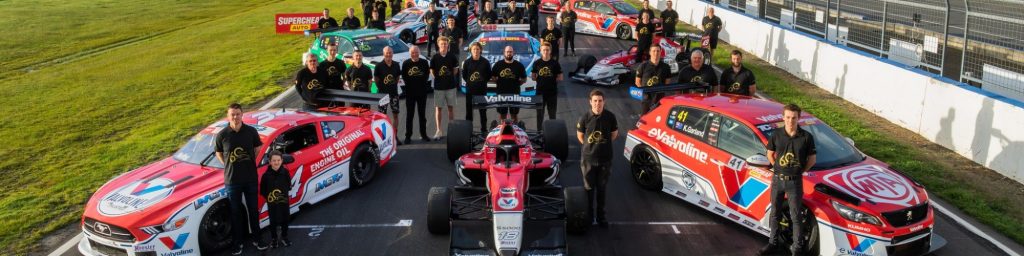
A tube-frame Ford Mustang built for the Trans Am grid, an open-wheel S5000 chassis, a Peugeot 308 shaped for touring car racing and an ex-Triple Eight Chevrolet Camaro bound for October’s Bathurst 1000 wildcard sit under the same roof in Melbourne’s eastern suburbs: four race cars built or maintained to four entirely different sets of rules, by the same team of engineers and fabricators.
Six decades of competition have developed GRM from Garry Rogers‘ weekend racing operation in 1963 into a multidisciplinary motorsport engineering organisation capable of designing, building and maintaining vehicles for the National Trans Am Series, TCR Australia, S5000 and Supercars.
GRM has been an early adopter of advanced composite manufacturing throughout its history, bringing techniques developed in high-performance industries into a motorsport workshop well ahead of many of its peers. Carbon fibre was adopted early and remains the material of choice where mass and stiffness matter most, though glass fibre, aramid and hybrid laminates, often paired with lightweight core materials, take over where cost, impact behaviour, repairability or production method make more sense.
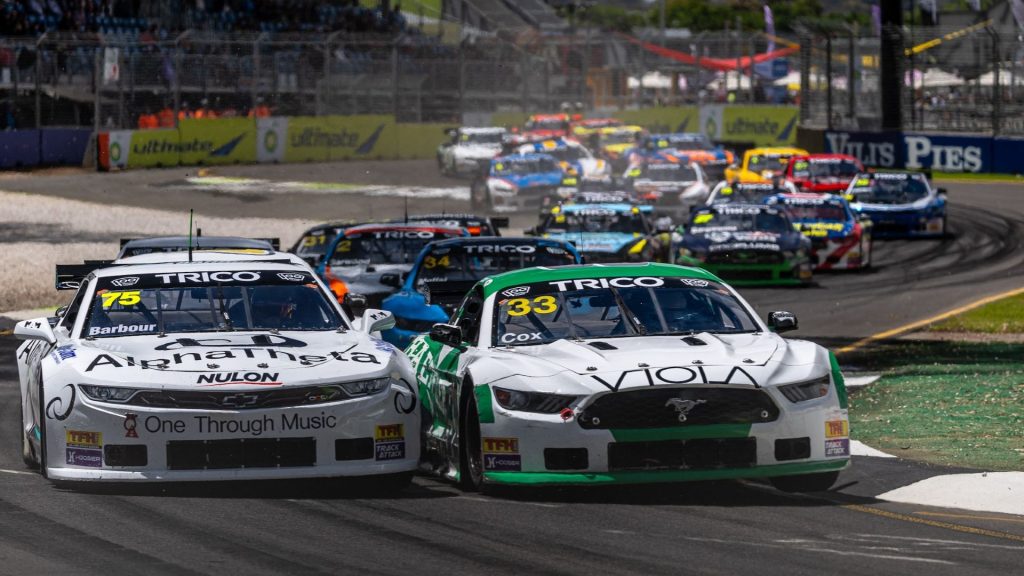
The #75 Camaro and #33 Mustang go side by side at the head of a National Trans Am field. These control-category cars run on a tube-frame chassis, often likened to NASCAR stock cars. Image credit GRM Gallery
GRM also invested in closed moulding and resin infusion processes, including controlled-temperature curing for composite panels, chassis tubs and components. Vacuum infusion provides controlled fibre-to-resin ratios and laminate consolidation, allowing structural composite components to be produced with repeatable properties without the cost and cycle times associated with autoclave processing.
Additive manufacturing followed the same drive to expand what could be produced within the workshop. Reinforced-polymer 3D printing has become a genuine production technology at GRM, not just for prototyping but for finished components, allowing the team to shave grams, refine a duct and tighten a tolerance where conventional manufacturing may be less efficient. It has helped close the gap between what CFD-driven designs call for and what the workshop can actually produce.
CNC machining has also become integral to the manufacturing process, providing the dimensional accuracy, repeatability and surface finish that lightweighting and aerodynamic efficiency demand in a high-stress racing environment.
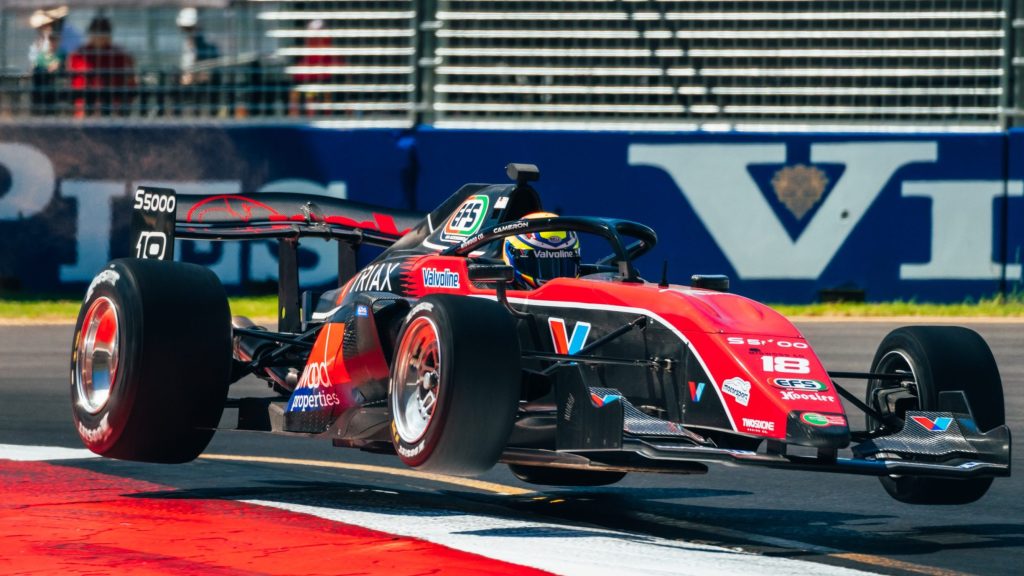
The #18 S5000, powered by a 5.0-litre V8, lifts its nearside wheels over a kerb. GRM built the category's first batch of cars and remains its technical partner. Image credit GRM Gallery
The clearest demonstration of this integrated approach came with S5000. Ahead of the category’s 2019 launch, Motorsport Australia appointed GRM as technical partner for Australia’s revived open-wheel V8 category, a 5.0-litre, naturally aspirated, Ford Coyote-based formula producing around 560 hp in a car weighing close to 890 kg, fast enough to exceed 300 km/h with almost no electronic driver aids.
The team developed and refined the race car package, handling vehicle integration, suspension development, cooling and brake-package optimisation, then testing and validating the car before the championship’s first race. It built and has maintained the fleet since. The work drew on CAD design, vehicle dynamics, chassis engineering and composite bodywork integration in combination: a complete vehicle development programme delivered end to end by an Australian team.
The result is a manufacturing and engineering base that extends beyond any single category. GRM now returns to Supercars, the category it left in 2019, with a wildcard entry for the 2026 Bathurst 1000 putting the team back on the grid for the first time in six years. Veteran James Moffat will share the car with debutant Nathan Herne, with the programme drawing on capabilities developed across GRM’s other racing programmes.
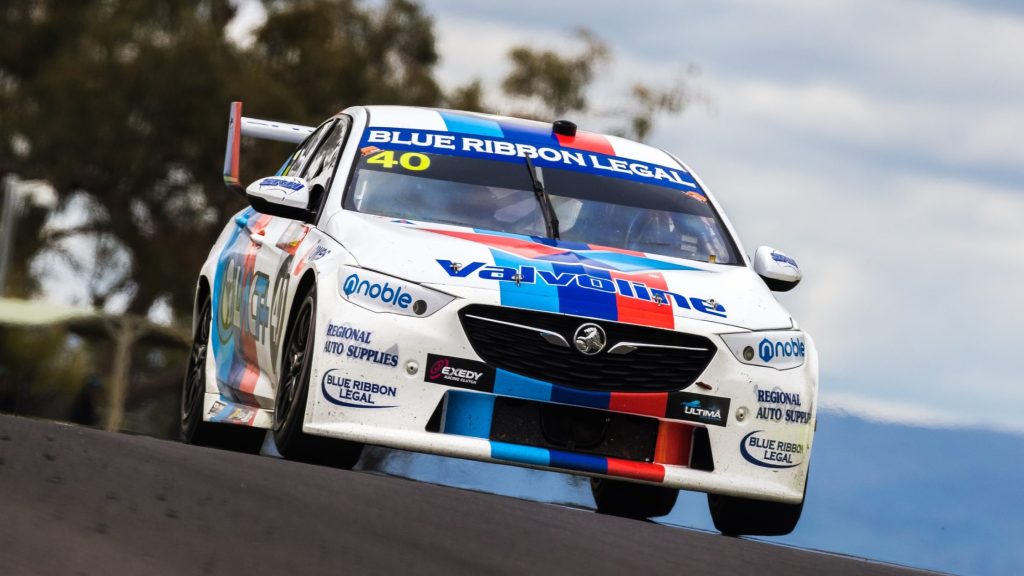
The #40 Valvoline Holden ZB Commodore crests the Mountain at Bathurst. Super2 is where GRM has long brought young drivers through to the Supercars main game. Image credit GRM Gallery
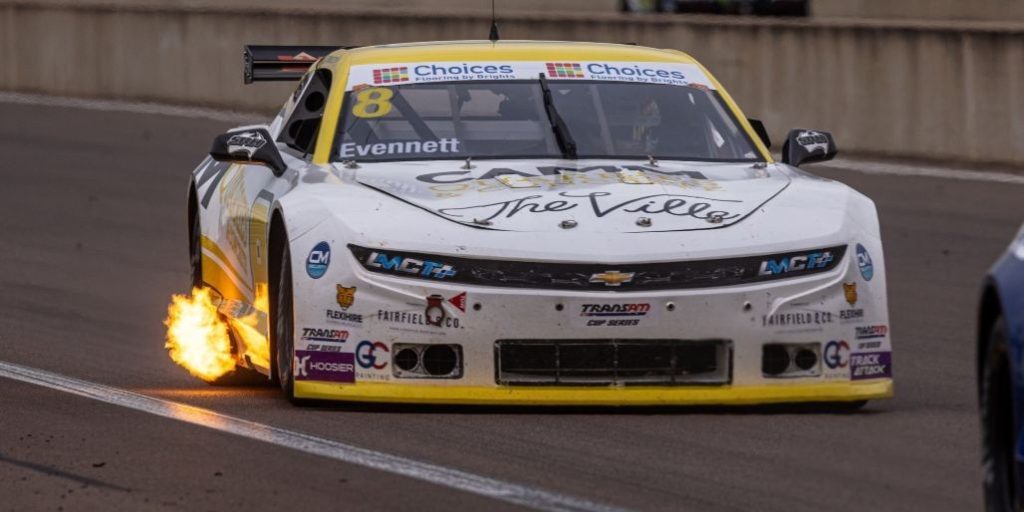
The #8 Chevrolet Camaro spits flame on the overrun. Trans Am cars run on a tube-frame chassis, a very different build philosophy from the monocoque construction of TCR and Supercars. Image credit GRM Gallery
The workshop’s role is not confined to contemporary competition cars. GRM has restored an ex-Peter Brock Monaro chassis for a private buyer and separately built a fourth Holden Monaro 427C to the specification of the cars that won the 2002 and 2003 Bathurst 24 Hour, for a client seeking an authentic, race-ready replica rather than a static display piece. Even builds that will never be raced are registered with Motorsport Australia, on the basis that a future owner may want to.
The team’s own 2000 Bathurst 1000-winning Commodore is kept on permanent display at the Melbourne workshop, brought out for historic events rather than left in storage.
Every car, whatever its architecture, is then built and maintained to Motorsport Australia’s technical and safety standards, the constant that runs underneath four otherwise unrelated build philosophies.
The GRM team marks 60 years in motorsport with cars from the Trans Am, S5000 and TCR categories and from its Supercars history. Image credit GRM Gallery
Founder: Garry Rogers
Garry Rogers Motorsport began in 1963, when Garry Rogers started racing Appendix J Holdens in Victoria. As a driver, he competed successfully in Sports Sedans through the 1960s and 1970s before moving into touring cars, racing Holden Toranas and making numerous starts at the Bathurst 1000 between 1978 and 1993.
His greater legacy, though, was as a team owner and mentor. The operation he built around his own racing evolved into a professional motorsport organisation that developed both technicians and drivers including Steven Richards, Jason Bargwanna, Garth Tander, Jamie Whincup, Lee Holdsworth and Scott McLaughlin, several of whom went on to become champions and Bathurst 1000 winners in their own right. Under his ownership, the team won the 2000 Bathurst 1000 and the 2002 and 2003 Bathurst 24 Hour races.
Garry Rogers died in October 2025, aged 80. His son Barry Rogers continues to lead the operation he built.
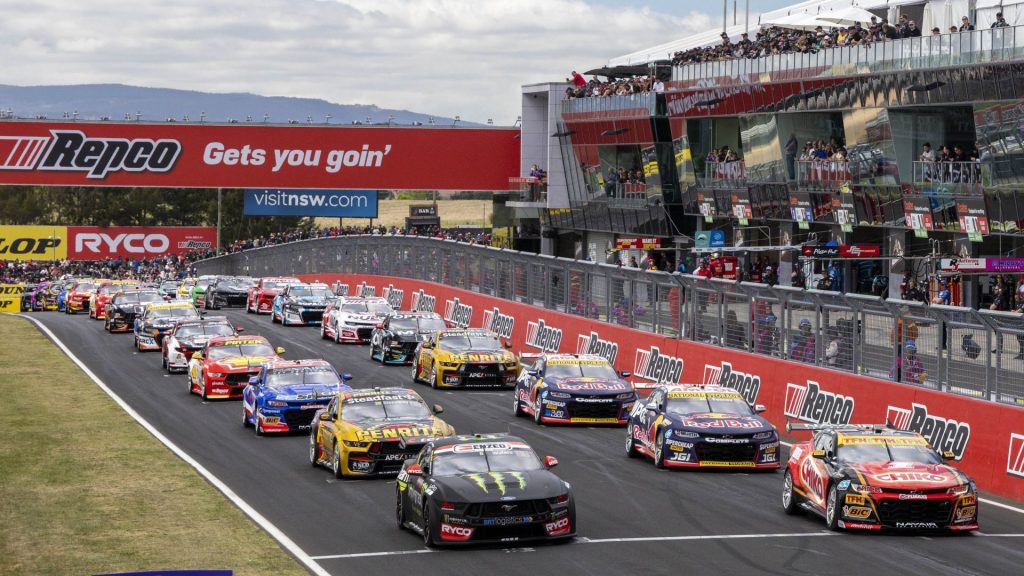
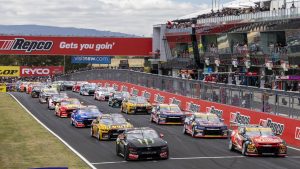
The Supercars grid at Mount Panorama, where composite bodywork must meet strict shape and weight rules. Edge Photographics/Supercars