Wagners CFT: Learning the load path before scaling internationally
Wagners Composite Fibre Technologies (CFT) has expanded from a three-person start-up into an international manufacturer of pultruded composite infrastructure, supplying electrical crossarms, poles and structural systems across energy and civil markets in Australia, New Zealand, North America, the United Kingdom and Europe.
Written by Kerryn Caulfield, Executive Director, Composites Australia Inc.
Wagners Composite Fibre Technologies (CFT) began in 2002 as a three-person start-up following the development of its proprietary pultrusion-based process. From an initial focus on utility crossarms, the company expanded into composite poles and structural civil systems, supplying electricity and infrastructure markets across Australia and New Zealand, and subsequently North America, the United Kingdom and Europe. International growth has been driven by technical validation, compliance with jurisdictional standards and controlled expansion of manufacturing and supply capability.
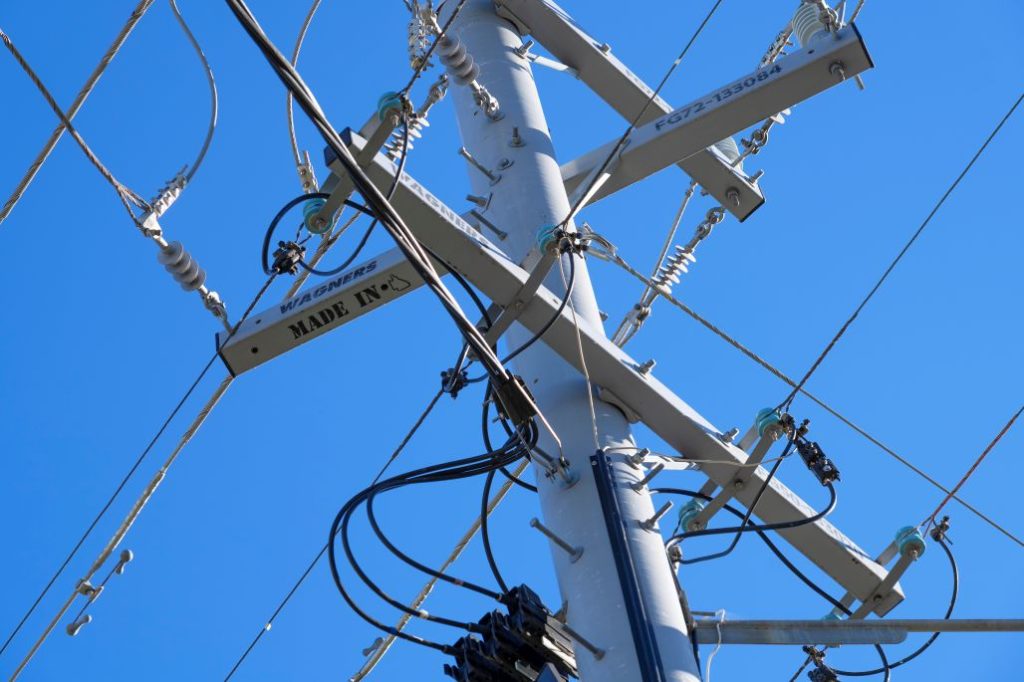
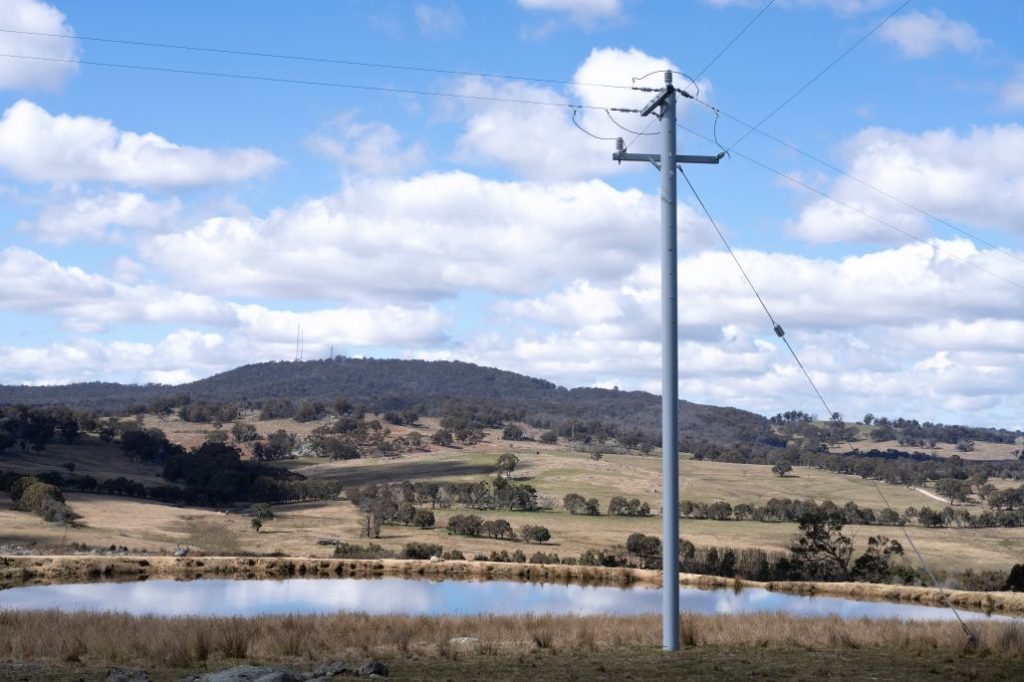
Composite pole fitted with electrical hardware and conductors, demonstrating
compatibility with distribution network infrastructure and in-field performance
requirements.
Electrical crossarms remain the company’s core product, with large volumes supplied globally across a broad design family covering low-voltage, high-voltage and sub-transmission applications. The business has expanded to pedestrian infrastructure and marine piles. Increasing exposure to extreme weather and severe service environments has prompted electricity networks to formally evaluate and ultimately adopt, Fibre Reinforced Polymer (FRP) materials for long-life infrastructure. Durability, fire performance, maintenance regimes and long-term structural reliability are now, after two decades of field deployment, proven. “The engineering case is no longer theoretical — it is demonstrated in the field,” said James Lorrimer, Global Utilities Lead at Wagners Composite Fibre Technologies.
Having secured domestic acceptance, Wagners CFT expanded first into New Zealand and the Pacific, followed by North America and the Middle East. Early international work centred on custom civil infrastructure projects — pedestrian bridges, boardwalks and public realm structures — delivered across varied climatic conditions and regulatory asset frameworks requiring engineering responses to corrosive, high-humidity, flood-prone and thermally variable service environments.
Representative projects include the Sulphur Point Boardwalk on Lake Rotorua, whereby composite structures replaced timber in a geothermal setting of chemically aggressive conditions and elevated temperatures.
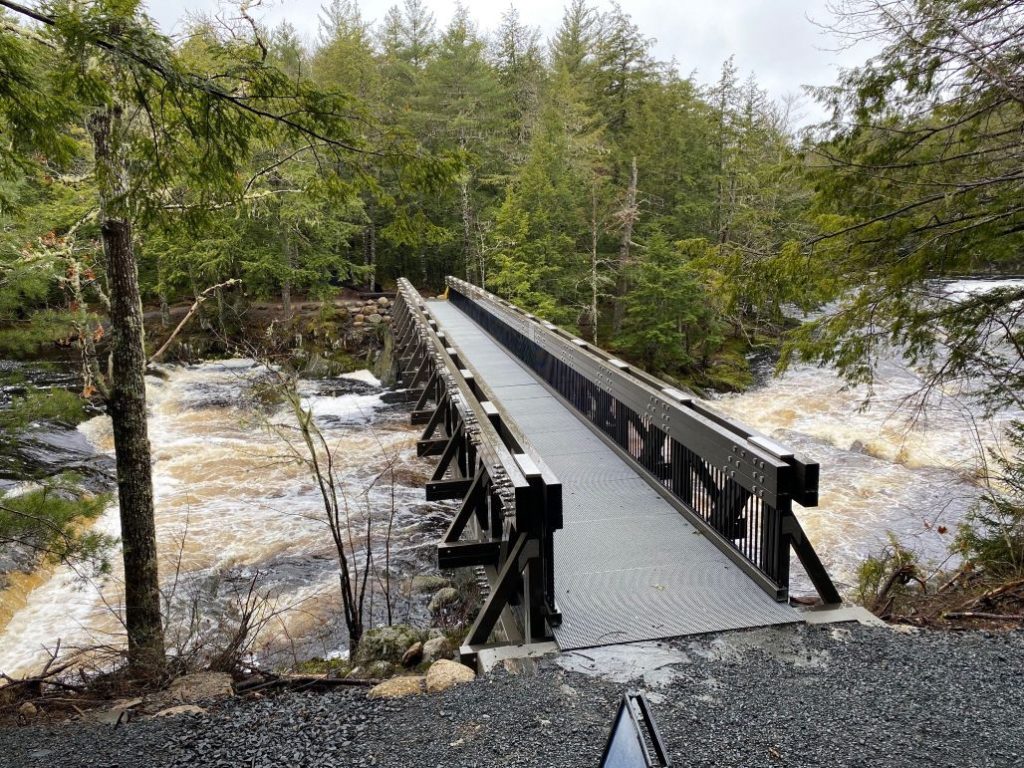
Mersey River bridge in Kejimkujik National Park, Nova Scotia, Canada, a 30-metre single-span, engineered to withstand frequent flooding, high winds and wide temperature variation.
The FRP’s elastic modulus was incorporated within the structural design to accommodate gradual ground movement. In Abu Dhabi, the Jubail Mangrove Boardwalk elevated pedestrian traffic above a sensitive marine ecosystem while meeting durability requirements in a saline coastal setting. In Canada, the 30-metre single-span Mersey River Pedestrian Bridge was engineered to withstand frequent flooding, high winds and wide temperature variation. This portfolio established working relationships with designers, asset owners and contractors across multiple jurisdictions, while developing operational proficiencies in logistics, quality assurance and technical support over distance.
Entry into electricity networks required a different pathway. Utilities operate within highly regulated asset standard frameworks. Acceptance was built through staged trials, technical validation, compliance with applicable standards, assured supply continuity and accumulated service data. Composite poles and crossarms are now installed at scale in Australia and New Zealand. A strong in-service record demonstrates the reliability of composite technology and is a compelling foundation for entering global markets.
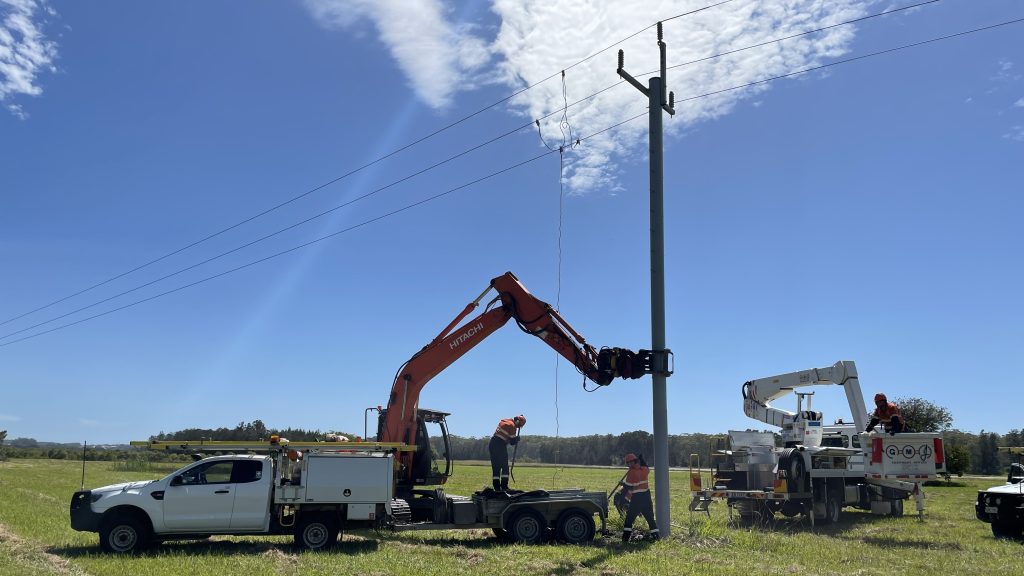
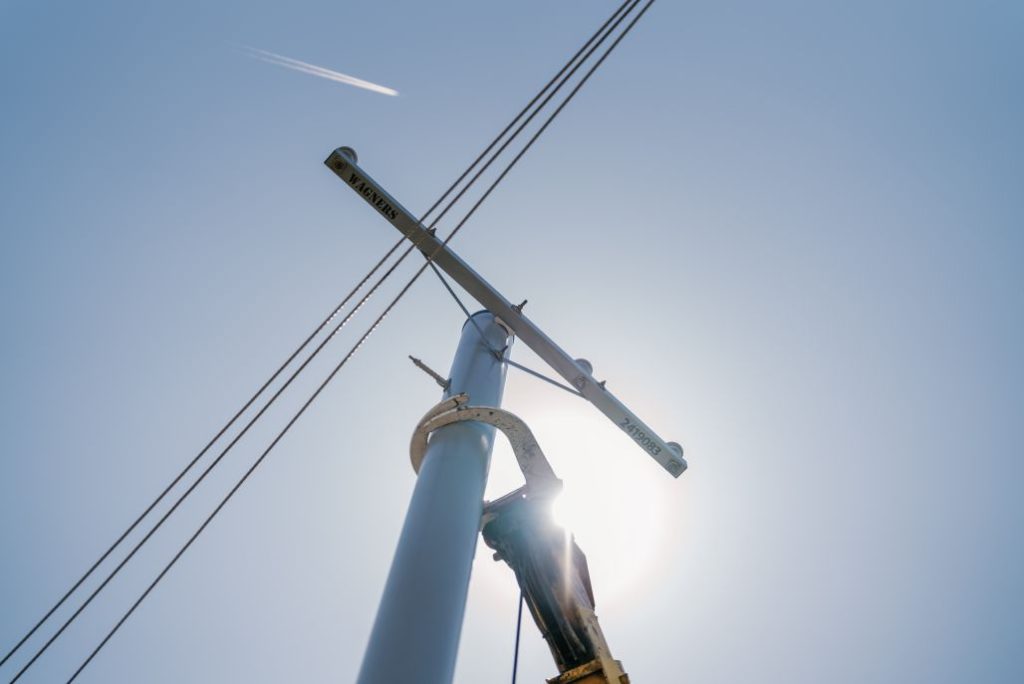
\Wagners composite pole and crossarm assembly in service, requiring adapted installation methods and the use of elevated work platforms rather than traditional spike climbing.
Each market entry has required a different supply chain model. In New Zealand, a commercial decision was made to establish wholesale distribution partnerships providing in-country stockholding. The model allows network buyers and field service providers to secure less than a shipping container of material at a time which frees up budgets and reduces issues around holding stock.
The decision to invest in manufacturing capability in the United States followed approximately five years of supplying the market from Australia. This period established an understanding of regulatory frameworks, procurement systems and regional variations in practice. Initial contracts were secured in municipal infrastructure, building technical credibility and relationships with local partners before progressing to specification-driven utility markets.
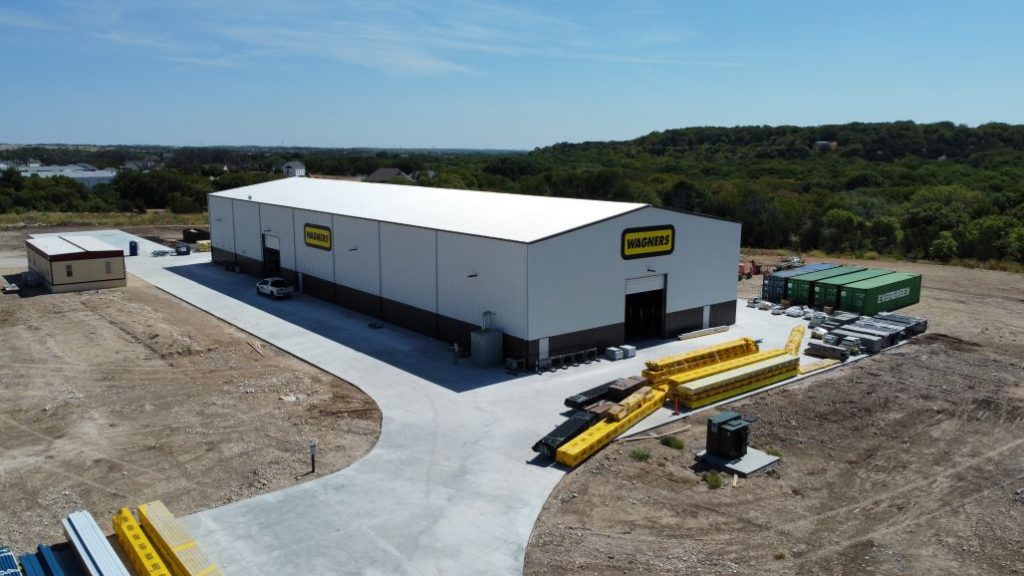
Wagners new facility at Cresson, south west of Fort Worth in Texas, located within a major electricity and infrastructure corridor with access to transmission and distribution networks, established road and rail freight routes.
Cresson, south west of Fort Worth in Texas was selected as the site for this investment, positioned within a major electricity and infrastructure corridor with direct access to transmission and distribution networks, established road and rail freight routes and a supportive industrial policy environment. The facility is being equipped with an in-house engineered pultrusion line, designed and constructed by Wagners’ engineering team in Toowoomba, Queensland. “Drawing on more than two decades of accumulated process knowledge and materials engineering, we are constructing equipment that replicates the operating conditions of our Toowoomba facility,” said Lorrimer. “That consistency is essential when transferring production into markets such as the United States.”
According to Lorrimer, the adoption of composite poles challenges installation and maintenance practices formed by more than a century of timber pole use. Alternative materials require different handling protocols, including installation methods and maintenance procedures, as well as the use of elevated work platforms rather than spike climbing. Market entry, therefore, involves structured field trials, engagement with line crews and training across asset, safety and operational teams.
“While EPDs provide valuable information they are also consistent with our internal values. Engineering transparency, data integrity and process discipline are embedded in the business. The EPD formalised that approach and positions us to compete in markets where verified lifecycle performance is a prerequisite.” James Lorrimer – Global Utilities Lead
The United Kingdom and European electricity markets are the next targets for expansion, with field trials involving major distribution networks scheduled to commence this year. The UK’s “ED3 (Electricity Distribution 3) – the next regulatory control period governing how UK electricity distribution network operators – stipulate environmental and resilience obligations which in turn influence material selection. Its timing positions Wagners CFT to engage with network operators during a defined capital planning window.
“As the use of traditional chemical treatments which extend the life of timber becomes increasingly restricted, networks are evaluating alternative materials,” Lorrimer said. “Composite poles are manufactured under controlled industrial conditions within hours rather than taking several decades to grow, altering the supply model and supporting long-term infrastructure planning.”
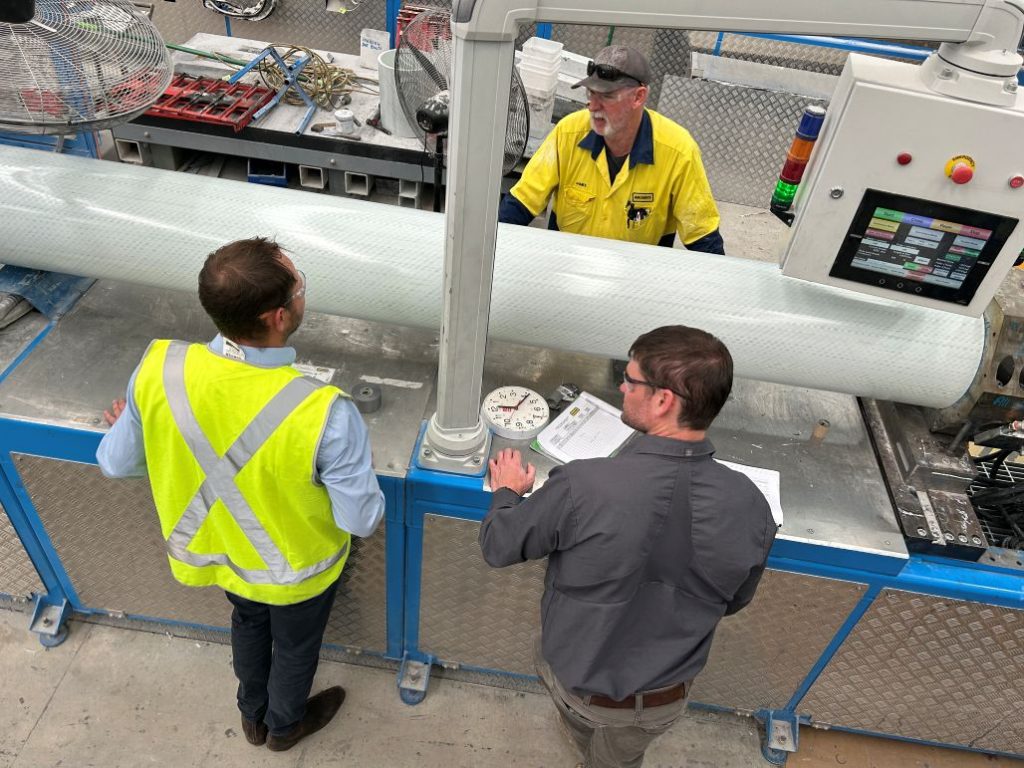
Engineers and operators overseeing
continuous production of a fibre-reinforced polymer (FRP) pole, where controlled resin injection and fibre architecture deliver consistent structural performance.
\Wagners composite pole and crossarm assembly in service, requiring adapted installation methods and the use of elevated work platforms rather than traditional spike climbing.
NEW RELIANCE ON COMPOSITE POLES
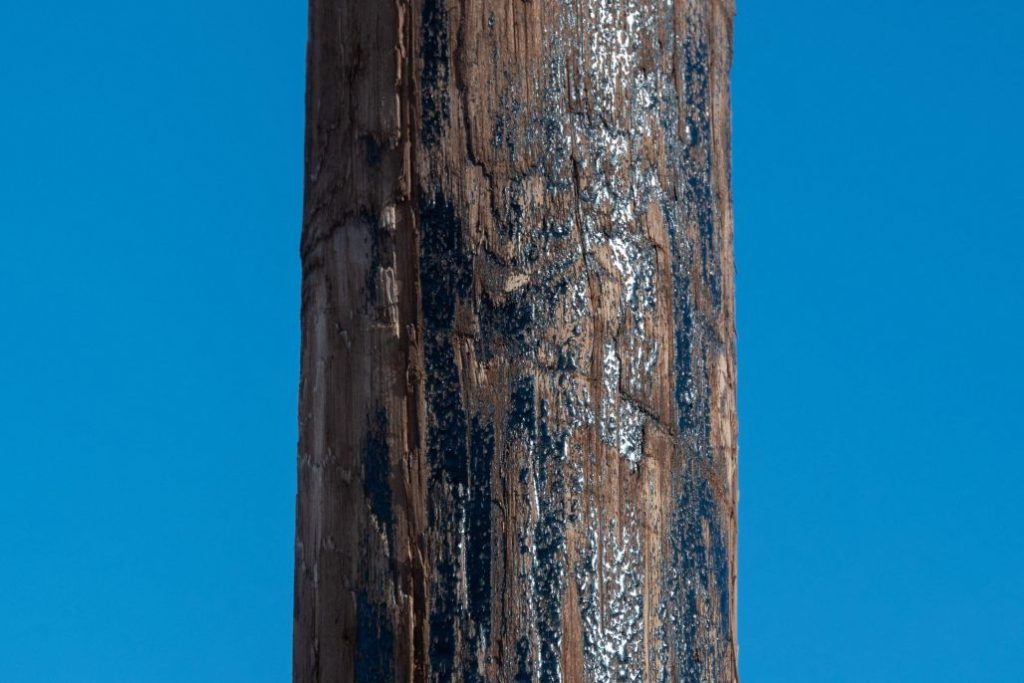
Hardwood utility poles require several decades to reach pole-grade dimensions — typically 40–70 years — constraining responsiveness within asset replacement cycles. Durability of timber poles has historically relied on preservatives such as creosote, a coal-tar– derived treatment used to resist fungal decay, termites and moisture ingress. Following its classification as a carcinogen, the European Chemicals Agency is progressively restricting the use of creosote.
With customers increasingly focusing on environmental impact of products, Wagners CFT has proactively sought independent third-party accreditation of its pultruded sections in 2023 through a verified Environmental Product Declaration (EPD) prepared under Life Cycle Assessment (LCA) methodology.
Durability of timber poles has historically relied on preservatives such as creosote, a coal-tar–derived treatment used to resist fungal decay, termites and moisture ingress. Following its classification as a carcinogen, the European Chemicals Agency is progressively restricting the use of creosote.
Embodied carbon within the built environment is frequently cited as accounting for up to 39 per cent of global emissions, placing material selection under increasing scrutiny. The LCA quantifies impacts across raw material extraction, production, use and end-of-life phases, while the EPD standardised these results for transparent comparison within specification processes.