Boeing Aerostructures Australia: Exporting Composite Aerostructures
Boeing Aerostructures Australia and Boeing Technology Innovation – Australia form part of Boeing’s integrated international industrial base, supplying Australian-made load-bearing aerodynamic control surfaces for final assembly in the US.
Boeing’s Australian Manufacturing Strategy: Written by Kerryn Caulfield, Executive Director, Composites Australia Inc.
Boeing released its Commercial Market Outlook in June last year, forecasting demand for 43,600 new passenger and freighter aircraft between 2025 and 2044. Of these, 21,100 aircraft are expected to replace ageing fleets, while 22,500 will support growth, expanding the global commercial fleet from 27,150 aircraft today to 49,640 by 2044. Delivering aircraft at this scale over multiple decades will require sustained production capacity and proven engineering and manufacturing technologies capable of producing high-quality composite structures with predictable performance and repeatability.
Within this global context, Boeing Aerostructures Australia (BAA) and Boeing Technology Innovation – Australia form part of Boeing’s integrated international industrial base. Operating from Fishermans Bend in Victoria, Boeing manufactures flight-critical composite aerostructures for global commercial aircraft programs. Production is export-oriented, with load-bearing aerodynamic control surfaces engineered and manufactured on site shipped to the United States for final assembly in Seattle and Charleston, forming a defined node within Boeing’s global production system. Boeing Defence Australia also currently supports defence manufacturing from the site.
Early collaborative research on composite processes in Australia commenced in 1991 with the establishment of the Cooperative Research Centre for Aerospace Structures, which evolved into the Cooperative Research Centre for Advanced Composite Structures in 1997. This partnership was instrumental in the development and industrialisation of advanced composite manufacturing technologies, including a scalable resin infusion process capable of producing large, flight-critical aerostructures at production rate. The process eliminated the need for traditional autoclaves: dry carbon fibre reinforcements are laid up on tooling and infused with liquid resin under controlled vacuum conditions before curing, enabling consistent fibre volume, dimensional control and structural performance. These methods were certified to Boeing’s airworthiness and quality standards and deployed into sustained aircraft production.
Advanced composite flight-critical
aerostructure components are produced at scale at Boeing Aerostructures
Australia’s Melbourne facility for global aircraft programs.
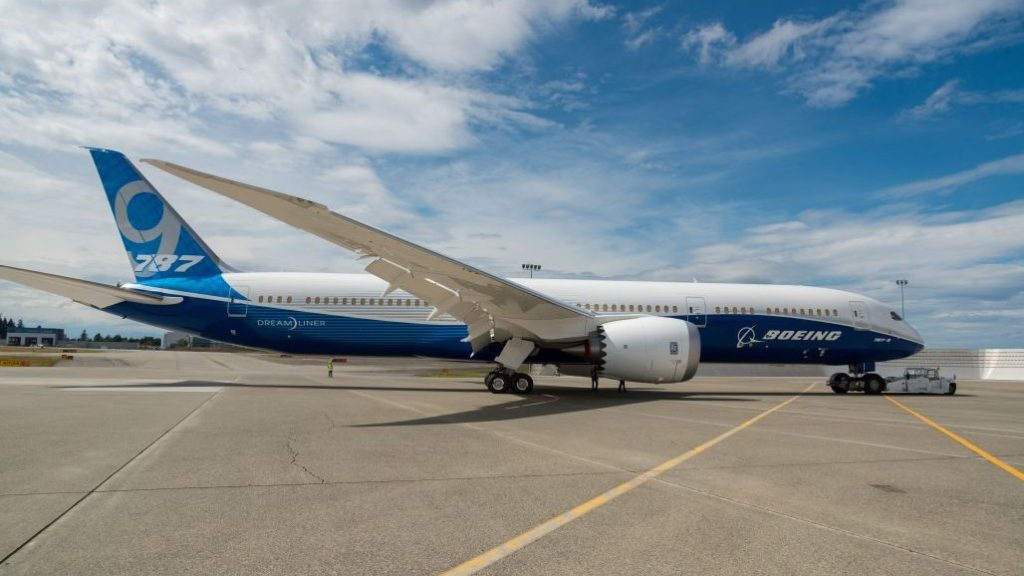
Resin infusion offers distinct advantages in manufacturing economics and scalability. Compared with autoclave-based systems, it reduces capital infrastructure requirements, lowered energy consumption and provided greater flexibility in part size and geometry. These characteristics aligned with the requirements of long-life aircraft programs such as the 787 Dreamliner, where components are delivered over decades, and production rates adjust in response to global demand.
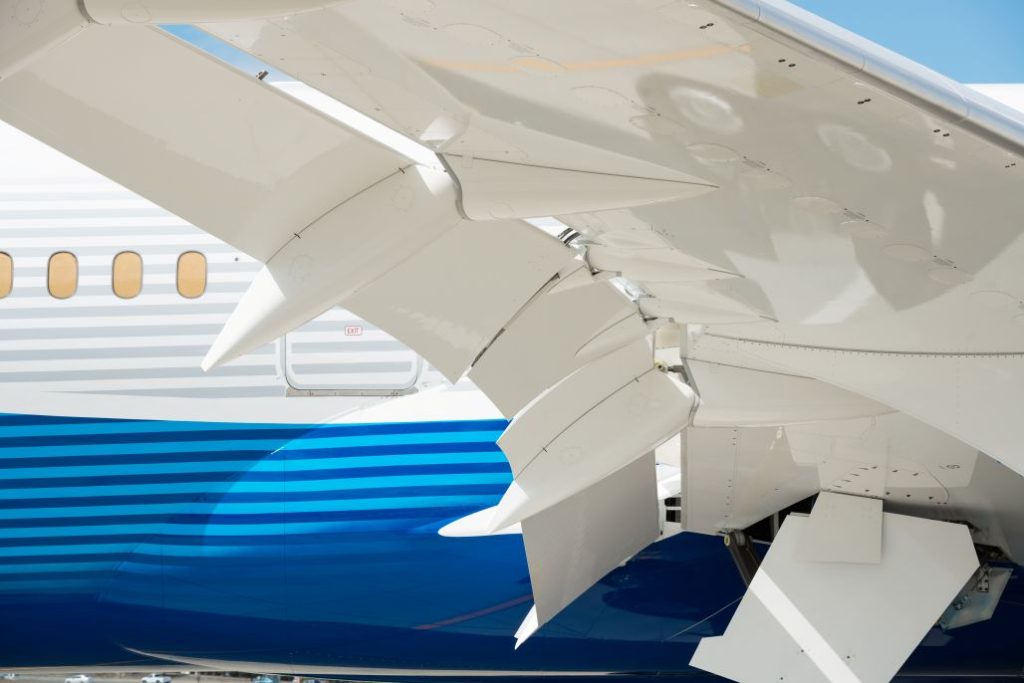
Alongside process industrialisation, Boeing’s Australian teams led applied research in resin chemistry, infusion behaviour and cure kinetics, delivering incremental process optimisation that shortened infusion and cure cycles, improved handling and safety characteristics and increased batch-to-batch consistency. New resin formulations and control methodologies were qualified and introduced into production with minimal disruption, often in collaboration with Australian universities. Through sustained process development and industrial validation, Boeing Aerostructures Australia design and manufactures a range of flight-critical composite control surfaces, including 787 Dreamliner flaperons, inboard flaps, outboard flaps and ailerons; 737 ailerons, rudder and winglets; and 777 rudders and elevators.
Advanced composite flight-critical
aerostructure components are produced at scale at Boeing Aerostructures
Australia’s Melbourne facility for global aircraft programs.
Automation and digital control were progressively integrated into composite production as resin infusion matured at scale. The process architecture, with greater tooling accessibility and flexible sequencing than prepreg–autoclave systems, enabled staged deployment of robotics and collaborative automation across lay-up, infusion and finishing operations. Industrial robots and cobots for drilling, trimming, cleaning and inspection of large composite control surfaces were integrated with digitally controlled infusion and cure systems to improve repeatability and reduce manual handling and exposure to repetitive or hazardous tasks. Digital engineering tools, model-based definitions and process simulation were embedded alongside physical production, allowing manufacturing sequences to be validated virtually before factory deployment. These methodologies were subsequently transferred across Boeing manufacturing operations globally.
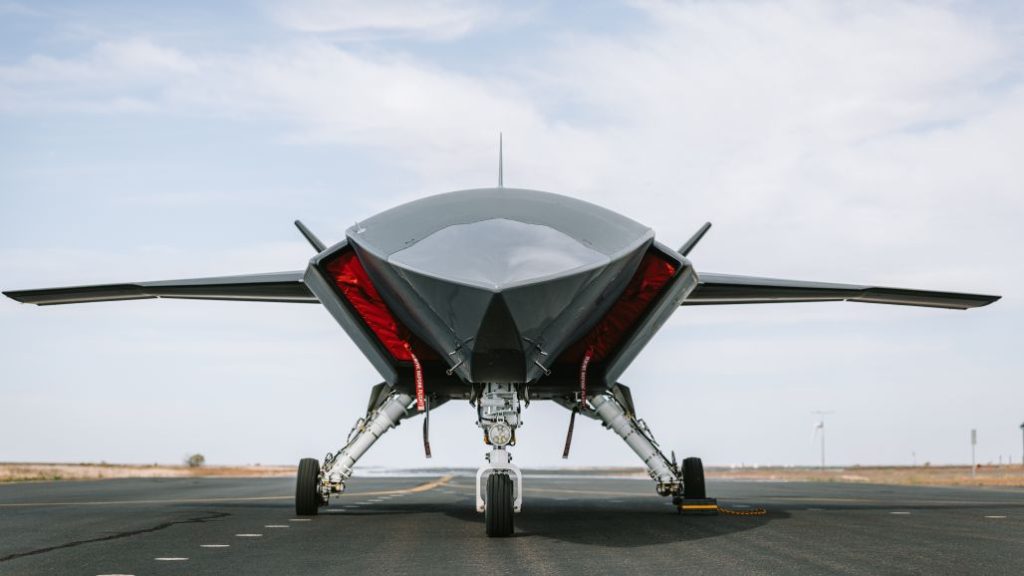
Ghost Bat uncrewed aircraft (11.7 m),
Australia’s first sovereign-designed and produced military combat aircraft in more than 50 years. It is Boeing’s first uncrewed system designed and developed in Australia, and its largest investment in a new uncrewed aircraft program outside the United States.
FROM THE 787 TO GHOST BAT
Australia’s role within Boeing expanded from component supply to full aircraft design, manufacture and industrial system development through the MQ-28 Ghost Bat program — the company’s largest investment in a new aircraft program outside the United States. The 38-foot (11.7-metre) jet-powered aircraft features a composite airframe engineered for range, payload integration and producibility, and represents Australia’s first sovereign-designed and produced military combat aircraft in more than 50 years. Designed for both autonomous operation and coordination with crewed platforms, the aircraft can perform a range of missions, with a fighter-like speed and range.
The manufacturing capability developed on the 787 program provided a foundation for the MQ-28 Ghost Bat. The air vehicle and its production system were developed concurrently, with extensive computational modelling and digital twin simulation used to validate tooling, cure cycles and assembly sequencing prior to first-article manufacture. Resin infusion technologies refined on commercial programs were scaled to produce some of Boeing’s largest single-piece composite structures. The program accelerated the use of robotic drill-and-fill, shimless assembly and additive manufacturing, removing manual drilling from final assembly.
More than 81 Australian companies, including BAE Systems Australia, Rosebank Engineering, AME Systems and Ferra Engineering, have contributed to the aircraft’s production. A production and final assembly facility is being built at the Wellcamp Aerospace and Defence Precinct near Toowoomba, which will accompany design and systems development activities in Melbourne longer term.
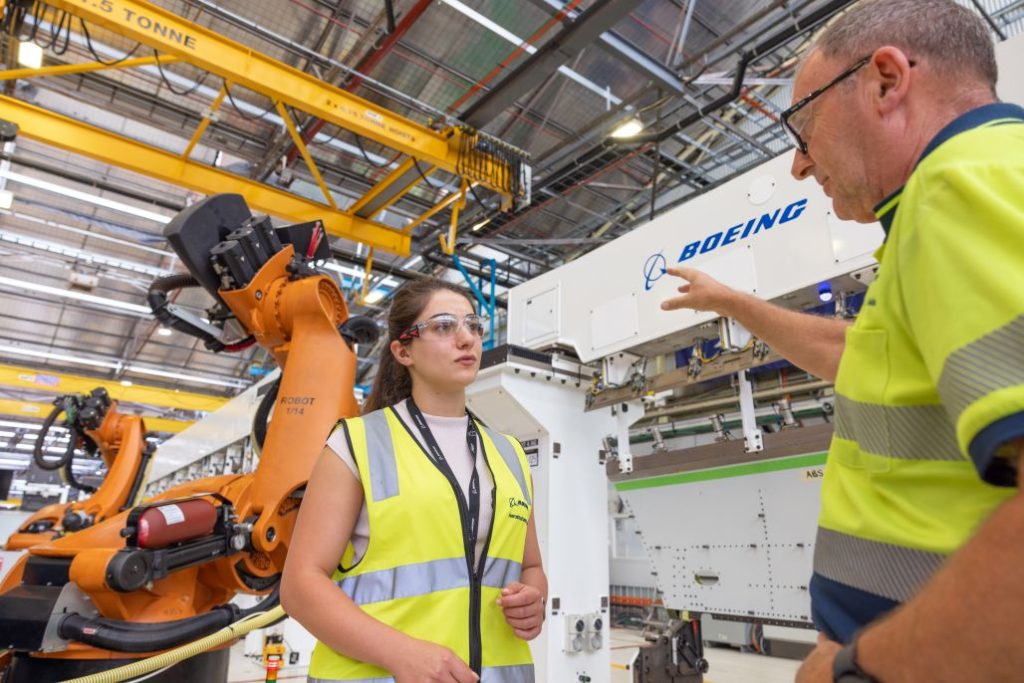
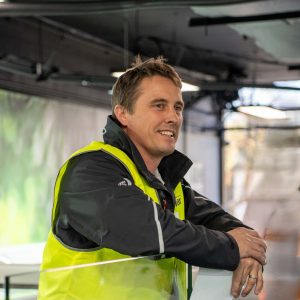
BAA Factory (VIC)-Gulbige Metin, Manufacturing Manager and Brian Arkison, Mechanical Assembly Technician
A TALENT PIPELINE
Boeing Australia’s contribution extends beyond component manufacture to engineering authority, production system design and sustained composite aerostructure manufacture at industrial scale — capability sustained by a dense engineering and skills base. Across its Australian operations, Boeing employs approximately 2,100 engineers spanning materials science, manufacturing engineering, automation, digital systems and air vehicle design. In Melbourne specific, an apprenticeship program, delivered in partnership with Aviation Australia and aligned with the Certificate IV in Aeroskills (Structures) (MEA41318), including growing the talent pipeline and increasing women’s participation in aviation trade roles.
Long-standing partnerships with Australian universities — including RMIT University, Swinburne University of Technology, the University of Melbourne and Monash University — support this capability through postgraduate research, industry-linked doctoral programs and applied research collaboration, feeding skills and technical expertise into Boeing’s global manufacturing and R&D activities.
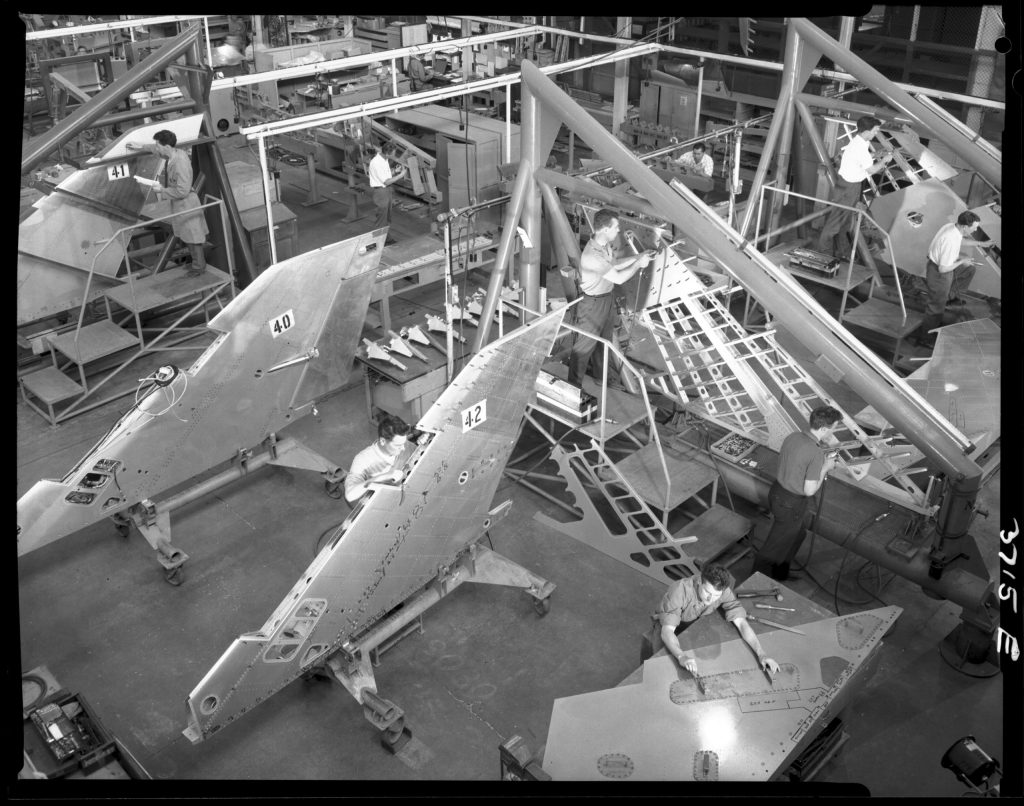
Wing construction for the Mirage Fighter at the Commonwealth Aircraft Corporation, Fisherman's Bend, Victoria, 1965
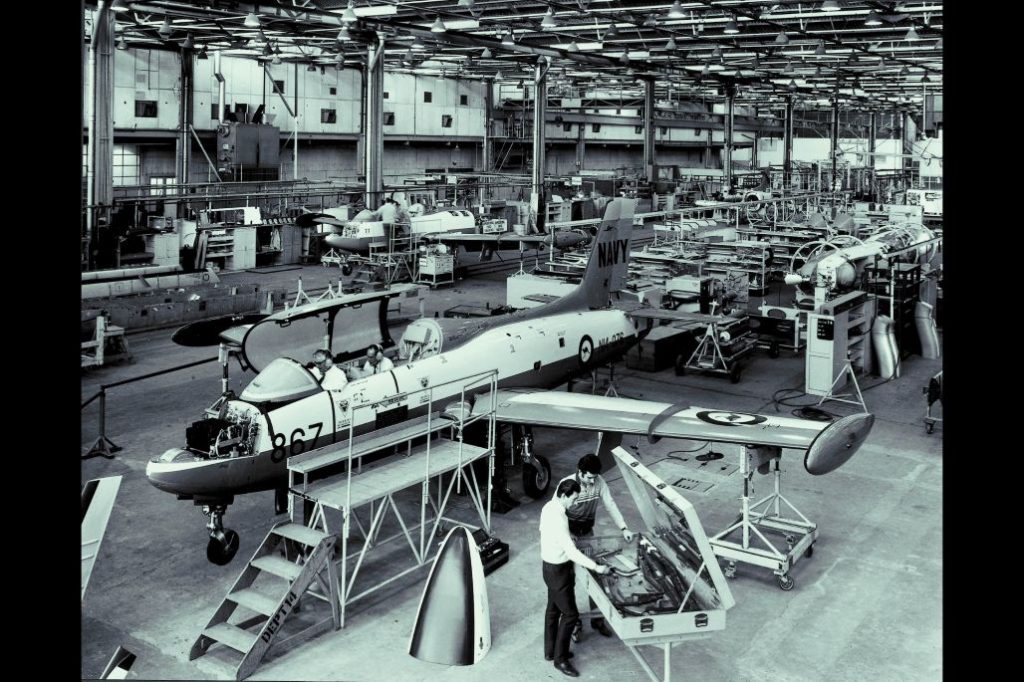
NAVY plane under construction Commonwealth Aircraft Corporation for RAAF, Fisherman's Bend 1970
Fishermans Bend in Victoria, one of Australia’s longest-standing aerospace manufacturing precincts, is home to Boeing Aerostructures Australia and Boeing’s Australian research and development facilities. The site has been a centre of aviation manufacturing since 1927, shaped by the legacy of the Government Aircraft Factory and the Commonwealth Aircraft Corporation and later by commercial and defence aerospace programs. Today, Fishermans Bend is one of Boeing’s most significant composite aerostructures manufacturing locations outside the United States, supplying flight-critical components to global aircraft programs and supporting advanced research in composites, automation and digital engineering.