Compass Pools: An Interview with Ian Mewett, Chasing Quality Through Chemistry
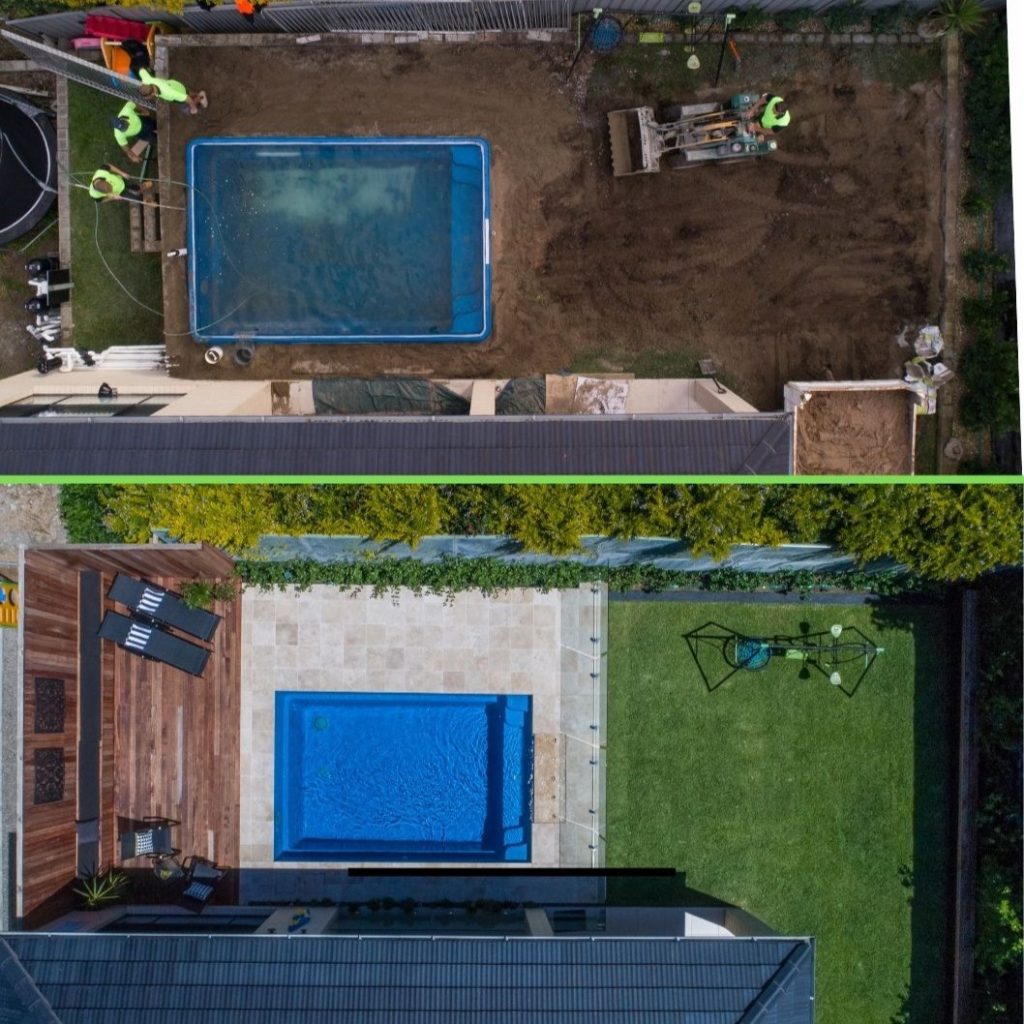
The moment it all begins. For these kids, it’s not just a pool arriving; it’s years of summer memories, laughter and family time taking shape right outside their front door. These values have driven Compass Pools' founders since 1980.
Written by Kerryn Caulfield, Executive Director, Composites Australia Inc.
A fortunate stroke of serendipity set Ian Mewett on the path to the fibreglass pool industry, though the foundations had been laid earlier. After leaving school to join the Australian Navy, he developed an appreciation for discipline, process and the importance of doing things properly the first time. Boat building followed, providing practical experience with fibreglass construction at a time when composite materials were emerging across many industries.
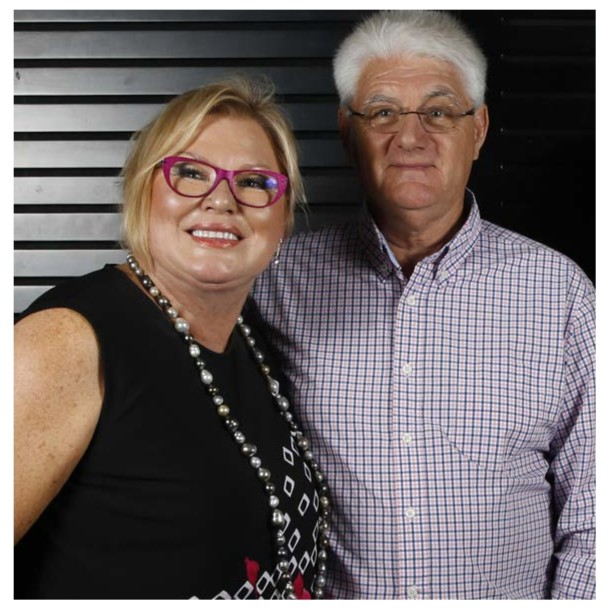
Built on partnership, driven by purpose. Ian and Kerri Mewett laid the foundations of Compass Pools with a shared belief that quality should never be compromised. It’s an ethos that continues to shape every pool built today.
The professional journey that followed was inseparable from his partnership with his wife, Kerri. The two married young and assumed responsibilities early, building their working lives alongside raising a family.
When Compass Pools was established in 1980, it was the continuation of a shared endeavour that had already begun shaping both their lives. Like many small manufacturers, the company grew through experimentation, persistence and a willingness to confront technical challenges as they arose.
For Ian and Kerri, the challenge was never simply to compete with concrete pools, which at the time held the lion’s share of the market. “Quality was our competitor,” Mewett says. “We chased quality through chemistry rather than chasing concrete.”
One of the early challenges was osmosis—a major source of warranty claims—arising when water penetrates the protective gelcoat. “The shift from polyester resins to epoxy vinyl ester chemistry was a turning point,” Mewett says. “It gave us a far more stable barrier against water ingress.”
The improvement was not inexpensive. Introducing epoxy vinyl ester chemistry increased material costs by around twenty per cent, yet the enhanced performance significantly reduced the likelihood of osmotic blistering and lowered warranty claims. As product reliability improved, the company gained the confidence to extend its warranty offering, strengthening consumer confidence in fibreglass pools as a durable, long-term alternative to concrete.
Structural design also became part of the solution. A fibreglass pool shell must withstand the combined forces of soil pressure, groundwater movement and the weight of the water it contains. Increasing panel stiffness became essential to minimise deflection under load. Drawing on principles familiar from marine composites, the company developed laminate structures incorporating a core layer to improve stiffness without significantly increasing weight.
“We were young and learning as we went,” Mewett says. “One of the discoveries that made a difference was the use of ceramic microspheres. They don’t absorb moisture and remain stable within the laminate. They work surprisingly hard for what is essentially an inert filler.” Within the pool structure, these materials performed several functions: reinforcing the corrosion barrier within the laminate, improving resistance to moisture migration, and supporting more controlled resin curing during manufacture. Continued refinements in formulation and application enabled the company to offer lifetime guarantees against structural failure.
For the Mewetts, each improvement was part of a larger objective—building a pool that could serve families reliably for decades.
Surface performance and appearance became another focus as the company refined its pool structures. Rather than relying on standard formulations, Mewett and his team developed their own gelcoat system, incorporating decorative chips to add visual depth and improve durability.
Achieving consistent application required collaboration with equipment manufacturers. The company worked with Robinson, a manufacturer of chopper-gun systems, to adapt spraying equipment to suit the viscosity and density of the new formulation.
Factory-moulded composite lap pool from Compass Pools, designed for consistent geometry, inbuilt features, rapid installation and long-term durability in residential settings.
The Compass Bi-luminite colouring system uses a dual-layer construction to produce a 3D visual effect when filled with water, a surface technology that strengthens competitiveness in international markets.
Much of the development occurred through experimentation. “Some of it happened by accident,” Mewett recalls. The resulting technology, later branded Crystite, combined decorative chips within the gelcoat with a customised application system designed to achieve consistent thickness and surface integrity. Building on this work, the company later introduced Bi-luminite, representing a further evolution of its surface technology in response to increasing competition in international markets.
While surface technology continued to evolve, these material
and process developments were complemented by system-level innovations,
including the introduction of the Vantage self-cleaning system. The integrated
in-floor cleaning system improved water circulation and directed debris towards
collection points within the pool.
Over time, self-cleaning systems became a defining feature of the company’s product offering. Today, Mewett notes, around seventy per cent of Compass pools incorporate self-cleaning systems, reflecting changing expectations among pool owners.
As the company matured, attention turned beyond Australia. In the United States, fibreglass pools—often referred to as one-piece pools—historically represented only a small share of the overall market, leaving significant room for growth. However, entering the United States market proved both an adventure and, at times, a misadventure.
Mewett first connected with Viking Pools in California, a manufacturer whose approach to fibreglass pools felt familiar despite the distance. “They were kindred spirits,” he says. “We shared an interest in improving the technology. They were taken with our colour range— vibrant blues and greens that glittered in daylight and under night lighting. We were also ahead in the way the pools were configured, incorporating features moulded into the shell itself rather than added later.” The relationship led to a technology transfer arrangement that helped introduce Compass surface technology into the United States.
The experience brought valuable lessons about international business and the complexities of operating in unfamiliar markets. Viking had ambitious expansion plans at the time, targeting significant annual production volumes, which made the business an attractive acquisition alongside Compass technology.
New Zealand became an early export destination, with hundreds of pools shipped across the Tasman. The business continues today through a dedicated distributor and dealer network, with the New Zealand market remaining an established part of the company’s international footprint.
Mewett notes that Australia’s geography meant many manufacturers operated in separate regional markets rather than competing directly—an environment that encouraged collaboration, stronger industry relationships and the gradual building of consumer confidence in fibreglass pools.
That collaboration extended to state governments, Standards Australia and the Swimming Pool & Spa Association (SPASA), contributing to the development of a comprehensive regulatory and training framework covering construction standards, installation licensing, safety requirements and certification. Often referred to as the “Australian model”, it helped build consumer confidence and subsequent international attention.
Innovation continues as manufacturers respond to changing lifestyles and housing patterns. Smaller plunge pools, suited to compact urban blocks and easier transportation, are emerging as a new area of development and are likely to open further export opportunities.
Although Ian Mewett retired from the business over 10 years ago, Compass Pools continues under the stewardship of Anthony Cross, CEO, guided by the values established at its founding. What began as the shared endeavour of a young couple learning their trade has grown into an international business, yet it still carries the character of the family enterprise they founded.
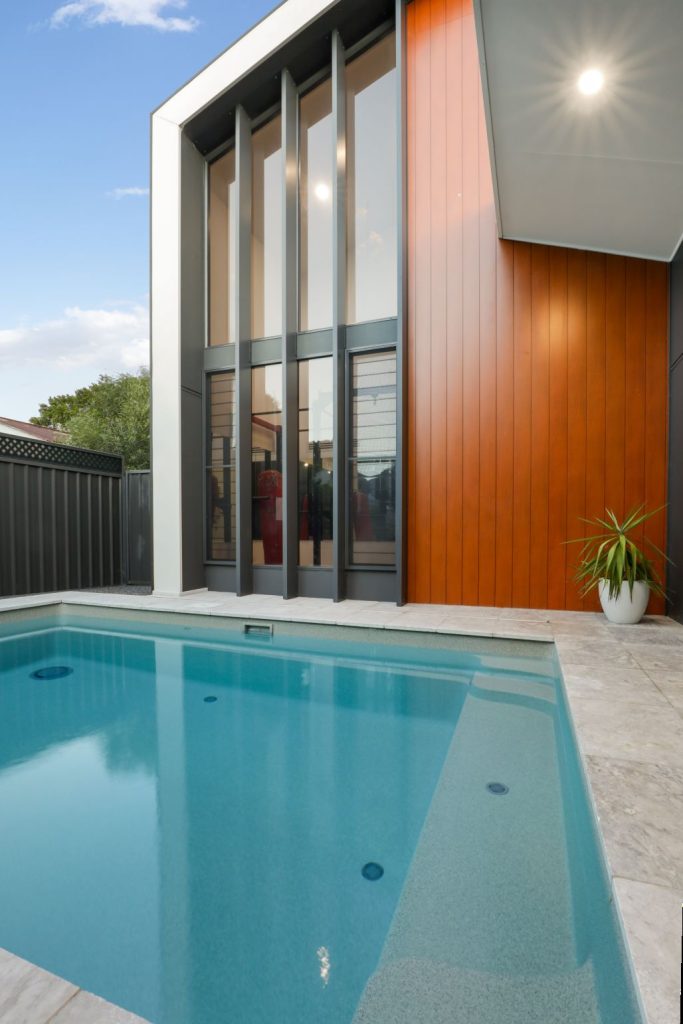
Designed for modern backyards, this 5m Plunge pool makes the most of compact spaces while delivering a clean, seamless finish. It’s a timeless outdoor setting built for quiet moments, everyday enjoyment, and years of family memories. Photo
credit: Compass Pools Newcastle