Talon Technology – Carbon-Kevlar Hinge: Born Global
A born-global product, Talon Technology’s co-moulded Carbon–Kevlar hinge replaces mechanical joints with a continuous composite structure, combining rigid carbon fibre laminates with a flexible Kevlar core - a thin, durable and repeatable product.
Written by Kerryn Caulfield, Executive Director, Composites Australia Inc.
The Carbon–Kevlar Hinge is a global product designed from the start for multiple sectors and international use. Uniquely, its continuous composite structure defines it as an alternative to conventional metal hardware. This repeatable, manufacturable and packageable component is lightweight, resists corrosion, simplifies installation and maintains a continuous load path. It offers durability, efficiency and weight savings not found in traditional options.
Based in Brookvale, Sydney, NSW, Talon Technology is a composite industrial design and R&D company specialising in carbon fibre consumer products. Its work centres on translating material behaviour into manufacturable components, and on designing and prototyping for clients in consumer electronics, furniture and sporting goods.
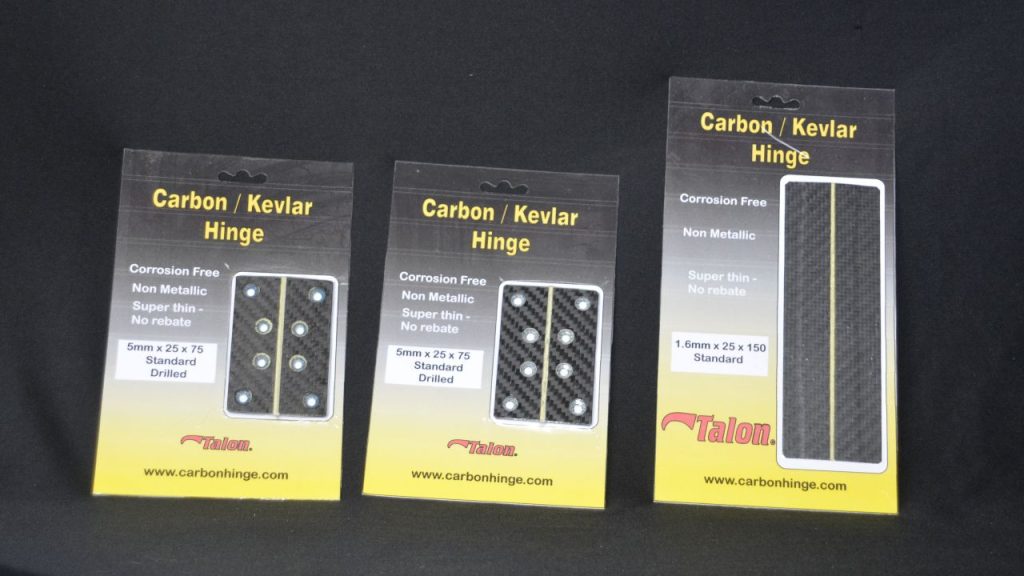
Retail format of the carbon fibre hinge in standardised sizes for high-volume distribution.
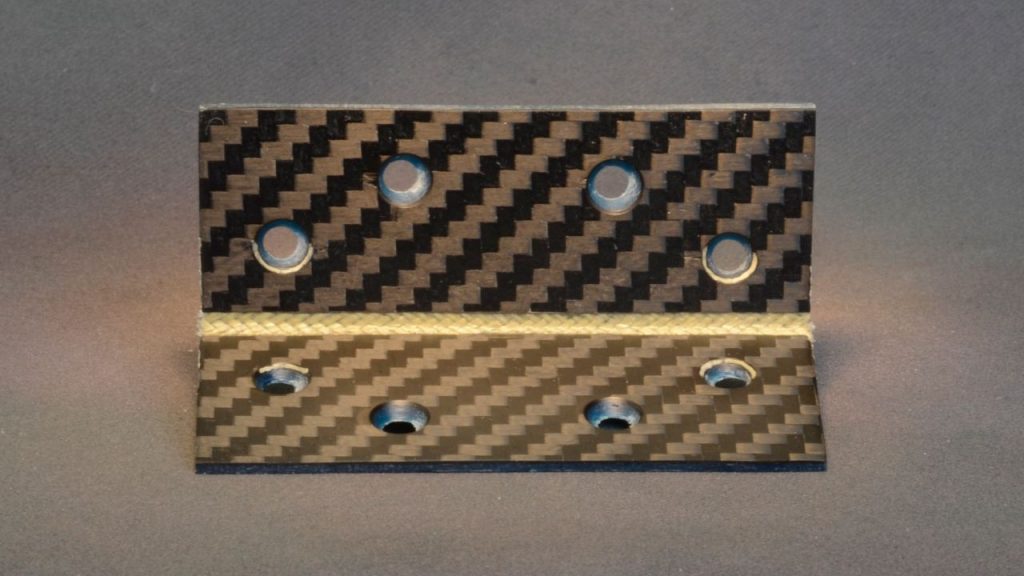
Co-moulded Carbon–Kevlar hinge integrating rigid composite wings
with a flexible centre section, eliminating the need for mechanical
fasteners.
The company was founded by industrial designer Geoff Germon. Talon’s earlier work in carbon fibre sporting goods includes the development of the world’s first composite field hockey sticks and high-performance surfboard fins that won the Australian Design award in 2005. The ‘Talon Chair’, developed in the 1990s, is now held in the Power House Museum collection. These products were introduced ahead of mainstream adoption and combined material innovation with scalable manufacturing.
The Carbon–Kevlar Hinge is an in-house product developed from the outset for international markets with over 90 per cent of sales destined for export. Its origin traces to the observation of a model aircraft, where scored CFRP panels produce a hinging action comparable to fabric or leather hinges. This led to an R&D program to develop a composite hinge without metal, achieving low weight and corrosion resistance while maintaining a continuous load path through the structure. Installation and integration are simplified by eliminating conventional mortise rebates and reducing reliance on mechanical fastening.
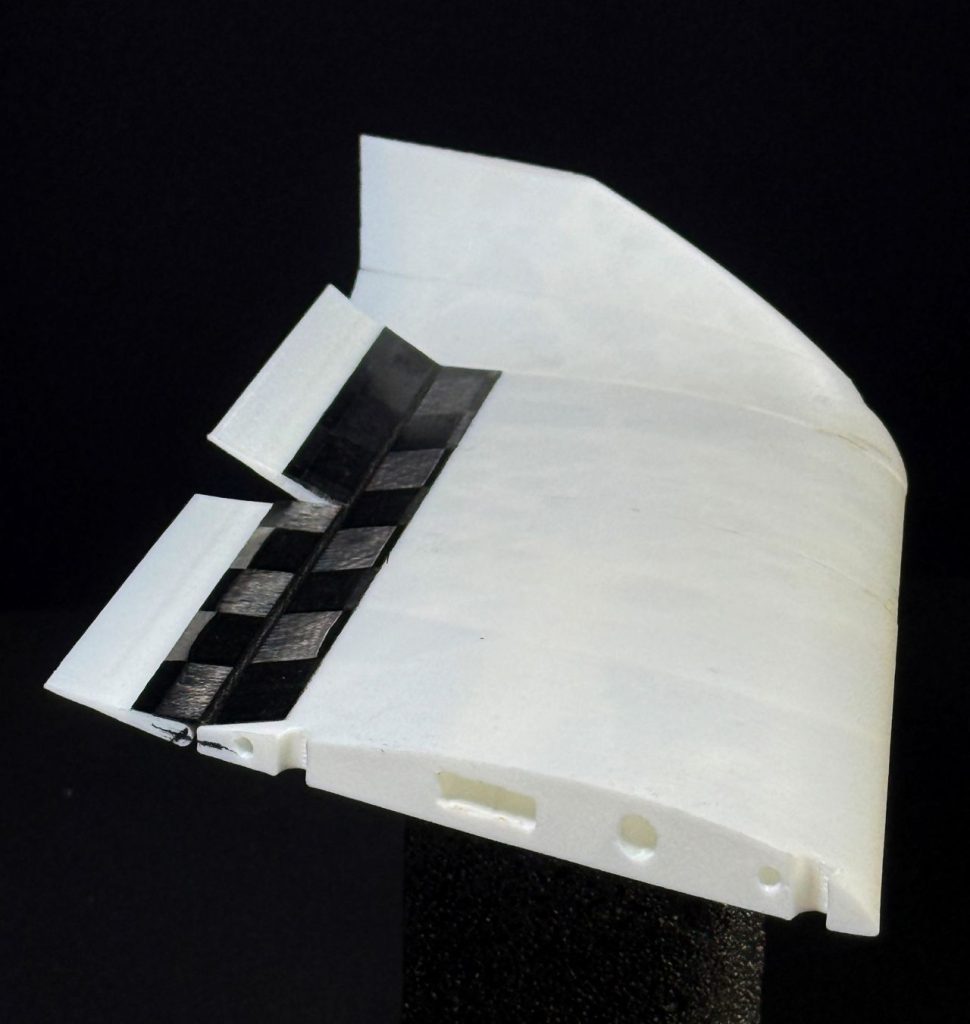
The Talon Carbon Hinge is now used in a wide variety of applications, from the world's most advanced drones to some of the world’s most expensive furniture and luggage.
The hinge combines rigid composite wings with a flexible centre. The wings are formed from woven carbon fibre in an epoxy matrix, with hybrid variants incorporating both carbon and glass fibres. The flexible element uses woven Kevlar impregnated with a tailored urethane system, enabling controlled movement while maintaining structural integrity. Developed through iterative work across material formulation, structural design and manufacturing process control, the co-moulded structure combines stiffness and flexibility into a single component, eliminating the need for pins, fasteners or metal interfaces.
Hinge variants have been developed in multiple thicknesses, widths and lengths with options for pre-drilling and countersinking. Kevlar flex units are available in single-layer or heavy-duty double-layer formats. The hinge is now used in a wide variety of applications from the worlds most advanced drones to some of the world’s most expensive furniture and luggage.
Ultra-thin variants, with a closed thickness of 0.8 mm, are suited to space-constrained applications, while thicker sections are designed to be installed with fasteners.
The hinge allows full rotation and has been cycle tested to over one million cycles. The pathway into advanced or regulated sectors—such as aerospace and defence—is rigorous, with defined qualification stages. In aerospace, formal assessment emphasises load behaviour and fatigue performance. In defence, additional requirements include stealth and radar transparency.
Beyond regulated sectors, the hinge is also used in standardised formats for high-volume production and distribution, including engineered-to-specification and standard applications. Developed in Australia and supplied internationally, the hinge is a born global product.
Although each sector values components that are lighter, stronger and more durable, their assessment and verification processes are tailored to specific needs of the customer, For us, each application becomes its own engineering challenge and where our speed and flexibility overcomes some of the problems associated with being distant from our markets.”
Geoff Germon – CEO of Talon Technology
Retail format of the carbon fibre hinge in standardised sizes for high-volume distribution.