Inside Australia’s newest shared manufacturing facility - Composites Australia and the Advanced Manufacturing Readiness Facility (AMRF) recently hosted a site-based TECH event examining how shared infrastructure is supporting Australian manufacturing.
Written by Kerryn Caulfield, Executive Director, Composites Australia
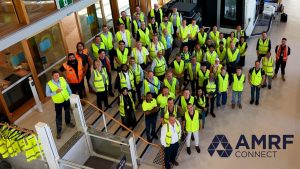
Composite industry, suppliers and academia recently came together at the AMRF to examine, at close range, what shared advanced manufacturing infrastructure now looks like in practice. Seventy participants attended the site-based event, with the discussion centred not on aspiration, but on how the facility is functioning as a practical tool for product development and scale-up.
As a state government initiative, the Advanced Manufacturing Readiness Facility sits within the emerging Bradfield City Centre, adjacent to the Western Sydney International Airport and within the Western Sydney Aerotropolis. The policy rationale positions the facility as a bridge between innovation and production, supporting productivity growth and the development of skilled manufacturing jobs.
It has been established as a shared-use facility designed to allow manufacturers to de-risk product development, validate manufacturing pathways and trial new technologies before committing to their own capital investment. For many in attendance, this capability addresses a long-standing constraint in Australian manufacturing: the gap between concept and scalable production.
Gareth Jones, Managing Director, Marley Flow Control
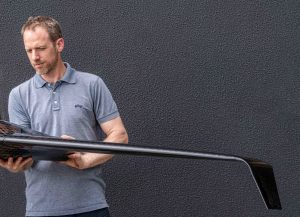
The program focused on applied outcomes. Gareth Jones, Managing Director of Marley Flow Control, outlined how access to the AMRF enabled the optimisation of its cooling tower fan technology. Designed for high airflow and pressure performance at reduced rotational speed, the low-noise fan system required close alignment between aerodynamic design, polymer tooling, composite manufacture and machining. The presentation demonstrated how the facility enabled rapid iteration and manufacturability testing using industrial-grade systems, and the practical value of accessing those systems without purchasing them outright during early production development.
Dr Nisa Salim, Director of the Swinburne University of Technology–CSIRO National Industry 4.0 Testlab for Composites, outlined the Testlab’s industrial-scale, multi-layer 3D printing capability for near-net-shape composite manufacturing. Operating as a fully automated production environment, the system integrates digital design, simulation and additive manufacture to reduce material waste, preform trimming and production cost for commercial-grade composite components.
Dr Nisa Salim, Director of the Swinburne University of Technology–CSIRO National Industry 4.0 Testlab
Luke Preston, Chief Technology Officer, Australian Composites Manufacturing CRC
Luke Preston, Chief Technology Officer, Australian Composites Manufacturing CRC, spoke to the sector’s longer-term trajectory, outlining how intelligent automation and data-driven manufacturing systems are reshaping expectations across production scale, quality assurance and digital integration. As these systems mature, automation and connectivity are fast becoming baseline requirements rather than optional upgrades.
Ben Leavold, Composites Engineer at the AMRF, spoke on the digital design considerations underpinning parts manufactured using large-format 3D-printed tooling. Drawing on his background in aerospace and automotive composites, he outlined how digital tool design, CNC machining, ply cutting, ply projection and hand lay-up are being integrated at the AMRF to support accurate, repeatable composite part manufacture using printed tooling systems.
“What distinguishes the Advanced Manufacturing Readiness Facility is the way the equipment has been deliberately selected to support an end-to-end manufacturing workflow,” said Nathan Howell, Lead Engineer, AMRF. “The current Stage 1 configuration spans engineering design, additive manufacturing, advanced composites, hybrid polymer tooling, precision machining, metrology and inspection, manufacturing automation and digital factory systems. A second building is planned for Stage 2, which is likely to serve sustained industrialisation, including high-precision, micro-electronics, and semiconductor-level manufacturing.”
A further layer sits above the physical machines: the
factory digital twin. By modelling production systems before they are built,
manufacturers can evaluate layout, throughput, automation strategies and
workforce interaction in a virtual environment. For industries working with
composites, where lay-up methods, cure cycles, trimming strategies and
inspection regimes strongly influence cost and quality, this integration of
digital and physical systems makes economic sense.
Nathan Howell, Lead Engineer, AMRF: explains the operation of the Langzauner heated thermoplastic forming press.
Notably, the AMRF’s mandate is centred on practical applied manufacturing. The Marley Flow Control example showed how the facility is intended to be used: to support iterative development, validation, and transition toward scalable production.
There is also a philosophical shift embedded in the shared-use model. Access to advanced manufacturing capability is no longer tied solely to ownership of equipment, but to timely use aligned with project needs. This introduces greater flexibility in how manufacturers structure development work and manage capital exposure, particularly for smaller firms.
The event itself reflected where Australian manufacturing now sits: technically capable, commercially cautious, and highly aware that future competitiveness will depend on how well digital systems, automation and materials processing are integrated. The AMRF does not resolve every constraint facing the sector, but it offers a practical mechanism for bridging the distance between concept, experimentation and production reality.
Evident across the day was both a clear appreciation of advanced machinery and a sharper interest in how the facility could be used to improve efficiency and reduce risk before capital is committed.
L to R: Clive Watts, Founder, CST Composites; Todd Jordan, Narellan Pools, Nathan Howell, AMRF and Kerryn Caulfield, Composites Australia
L to R: Nathan Howell, Lead Engineer, AMRF; Benjamin Leavold, Composite Development Engineer, AMRF; Kerryn Caulfield, Executive Director, Composites Australia and Damien Bensley, General Manager of Colan Australia.
A bird's eye view of the AMRF showing what shared advanced manufacturing infrastructure now looks like in practice.
The AMRF is a bridge between innovation and production, supporting productivity growth and the development of skilled manufacturing jobs.